
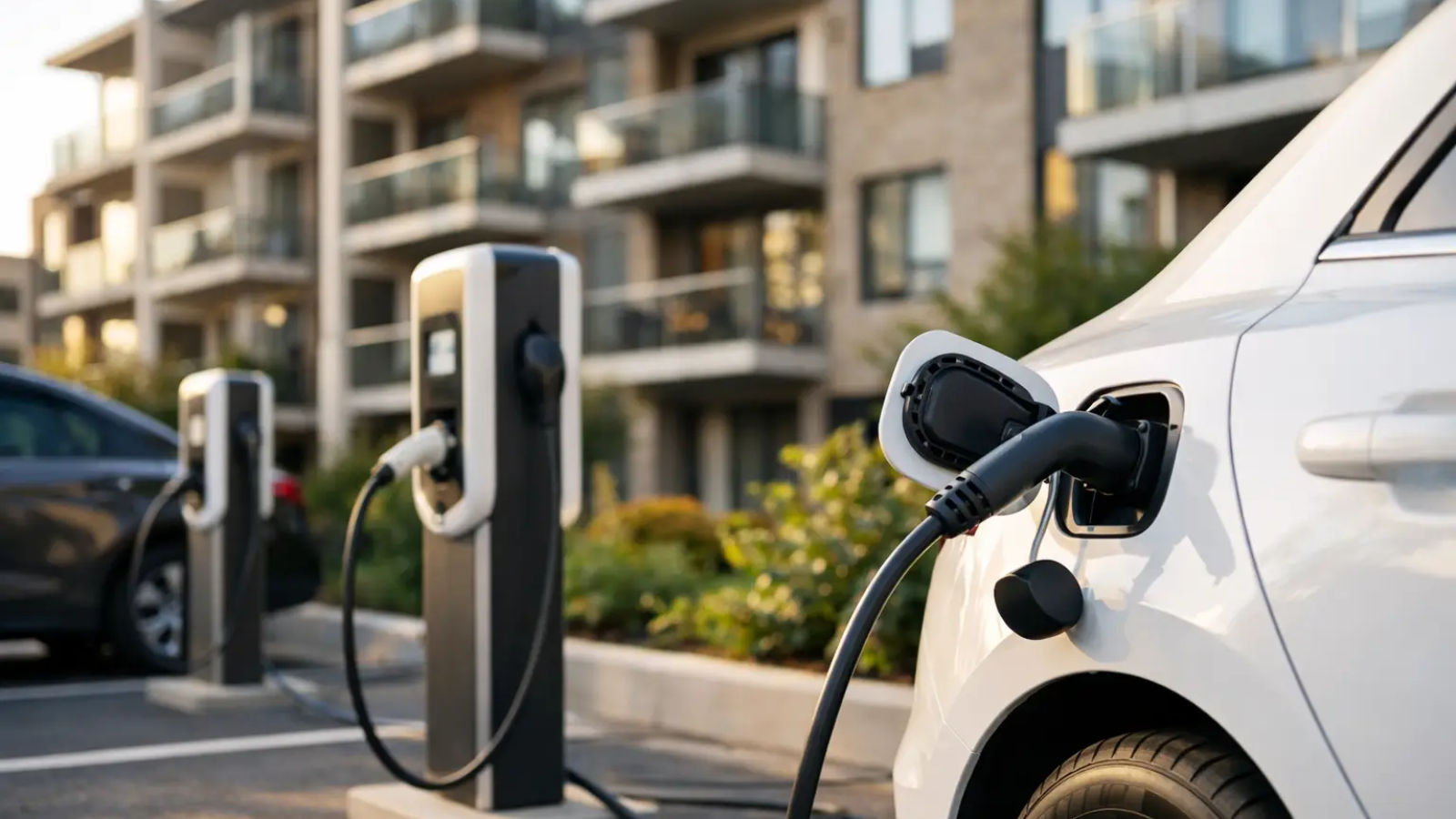
A tenant buys an EV, gets the keys, and then hits the real question: where do I charge if my car sleeps in a shared garage? That is where apartment EV charging solutions move from nice-to-have to necessary. For multifamily properties, charging is no longer a fringe amenity. It is becoming part of the baseline for modern parking, resident retention, and long-term property value.
The challenge is that apartment buildings are more complex than single-family homes. Parking is shared, electrical capacity is finite, billing has to be fair, and not every resident needs charging at the same time. The good news is that there is no single model every property must follow. The best approach depends on the building, the residents, and how quickly ownership wants to scale.
Why apartment EV charging solutions are different
A house with a driveway usually needs one charger, one meter, and one driver. An apartment community may need to serve dozens or hundreds of drivers across assigned, unassigned, covered, or outdoor parking spaces. That changes everything.
Property managers have to think beyond hardware. They need to know whether the electrical room can support new loads, whether chargers should be tied to resident billing or offered as a shared amenity, and whether the first installation should be small or built for expansion. A charger that works perfectly in a private garage can become difficult to manage in a multifamily setting if access control, load balancing, and payment options are missing.
This is also where timing matters. Installing too little can frustrate residents as EV adoption grows. Installing too much too early can tie up capital in stations that sit underused for years. Smart planning usually starts with current demand, then builds in a clear path to add more capacity without redoing the whole system.
The main models for apartment EV charging solutions
Most multifamily properties land on one of three models, or a mix of them.
The first is assigned charging. In this setup, a resident gets a dedicated parking space with a charger tied to their unit or account. This works well in properties with assigned parking and a stable resident base. It feels predictable for the driver, but it can become expensive if every future EV driver expects a dedicated station.
The second is shared charging. A small number of chargers are installed in common areas for resident use. This lowers upfront cost and lets a property test demand before expanding. The trade-off is convenience. Shared charging needs clear parking rules, app-based access, and a fair pricing model so a few drivers do not monopolize the stations.
The third is charger-ready infrastructure. Instead of installing many active chargers at once, the property invests in electrical backbone work such as conduit, panel upgrades, and capacity planning. Then chargers are added as demand rises. For newer developments and major renovations, this is often the most cost-effective long-term strategy because the difficult infrastructure work is handled early.
Start with power, not the charger
One of the biggest mistakes in multifamily EV planning is focusing on charger models before understanding the building’s electrical reality. A site assessment should come first.
That assessment looks at available service capacity, panel space, parking layout, distance from electrical rooms, and the number of spaces likely to need charging over the next few years. In some buildings, the existing system can support several Level 2 chargers with minimal upgrades. In others, even a small installation may require panel work, transformer coordination, or energy management software to avoid overloading the system.
Load management can make a major difference here. Instead of delivering maximum power to every charger all the time, a managed system distributes available power dynamically. That means a building may be able to support more charging ports than its raw electrical capacity would suggest. Residents still charge overnight, and ownership avoids unnecessary upgrade costs.
For many apartment communities, this is the difference between a practical rollout and a stalled project.
Billing and access need to be simple
The hardware gets attention, but operations determine whether residents actually see the program as useful. Billing is a good example.
If electricity costs are absorbed into rent or HOA fees, non-EV drivers may object. If residents are billed manually, management creates extra admin work. If access is unrestricted, guest vehicles or unauthorized users may take advantage of the stations. Apartment EV charging solutions work best when the software handles authentication, session tracking, and billing automatically.
That can mean residents use an app, RFID card, or account-based system to start charging and pay for what they use. In some properties, pricing is set to recover electricity and maintenance costs. In others, charging is offered at a subsidized rate as part of a premium amenity strategy. There is no universal right answer. A luxury property may use charging to strengthen resident experience, while a budget-conscious building may focus on strict cost recovery.
The key is transparency. Residents should know who can use the chargers, what they pay, how long they can park while charging, and what happens if demand exceeds supply.
Level 1 vs. Level 2 in apartment settings
Not every building needs high-powered charging everywhere. In fact, matching charger speed to dwell time is one of the smartest ways to control costs.
Level 1 charging uses a standard outlet and adds range slowly. It can be viable in limited situations where cars remain parked for long periods and daily mileage is low. But for most apartment communities, Level 1 is too slow and too difficult to manage at scale.
Level 2 charging is the more practical standard for multifamily use. It gives residents meaningful overnight charging and supports a wider range of vehicles and driving habits. For properties trying to serve working professionals, families, and commuters, Level 2 usually offers the right balance of speed, installation cost, and user satisfaction.
DC fast charging is rarely the first choice for apartment buildings because of its higher cost and power demands. It may fit certain mixed-use or premium developments, but for most multifamily properties, it is more infrastructure than residents need for routine overnight parking.
What renters can do if the building is not ready
Renters often assume charging decisions are out of their hands. That is not entirely true.
A clear request to property management can help, especially when it is framed around resident demand, property competitiveness, and practical implementation. A landlord may ignore a vague complaint but respond to a simple case: EV adoption is rising, nearby properties are adding charging, and a phased solution could attract and retain tenants.
It also helps when renters understand the options. Asking for a dedicated charger in one assigned space is different from asking management to electrify the entire garage. In many cases, a pilot with one or two managed Level 2 chargers is easier for ownership to approve than a large capital project.
For condo boards and HOAs, resident education matters just as much. Decision-makers need to hear how charging can be added fairly without shifting unreasonable costs onto households that do not drive EVs. Good planning reduces conflict.
Sustainability value goes beyond convenience
Charging access supports EV adoption, but its value is broader than convenience. For apartment owners and developers, it signals that the property is built for where transportation is headed, not where it was five years ago.
That matters to residents who see sustainability as part of daily life, not just a slogan. It also creates a stronger case when paired with broader energy strategies such as solar integration, energy monitoring, or smart building upgrades. A property that connects transportation electrification with cleaner energy use is making a more durable investment in efficiency and resilience.
This is where a solutions-based provider can add real value. Charge & Go, for example, sits at the intersection of EV charging and clean energy planning, which is exactly where multifamily decisions are heading. The charger matters, but the bigger opportunity is building an energy ecosystem that works over time.
The best solution is usually phased
The strongest apartment EV charging solutions are rarely all-or-nothing. They start with a realistic demand forecast, install the right backbone infrastructure, and use software to stretch available power and simplify billing. Then they expand in step with resident adoption.
That phased approach respects both sides of the equation. Residents get practical access to charging without waiting for a perfect future buildout, and property owners avoid overcommitting before demand is proven. It is a cleaner path to growth, both financially and operationally.
If your property is considering EV charging, the most useful next step is not choosing a charger from a brochure. It is asking better questions about power, parking, policy, and long-term demand. The right system is the one that fits how people actually live, park, and charge.
Add a Comment