
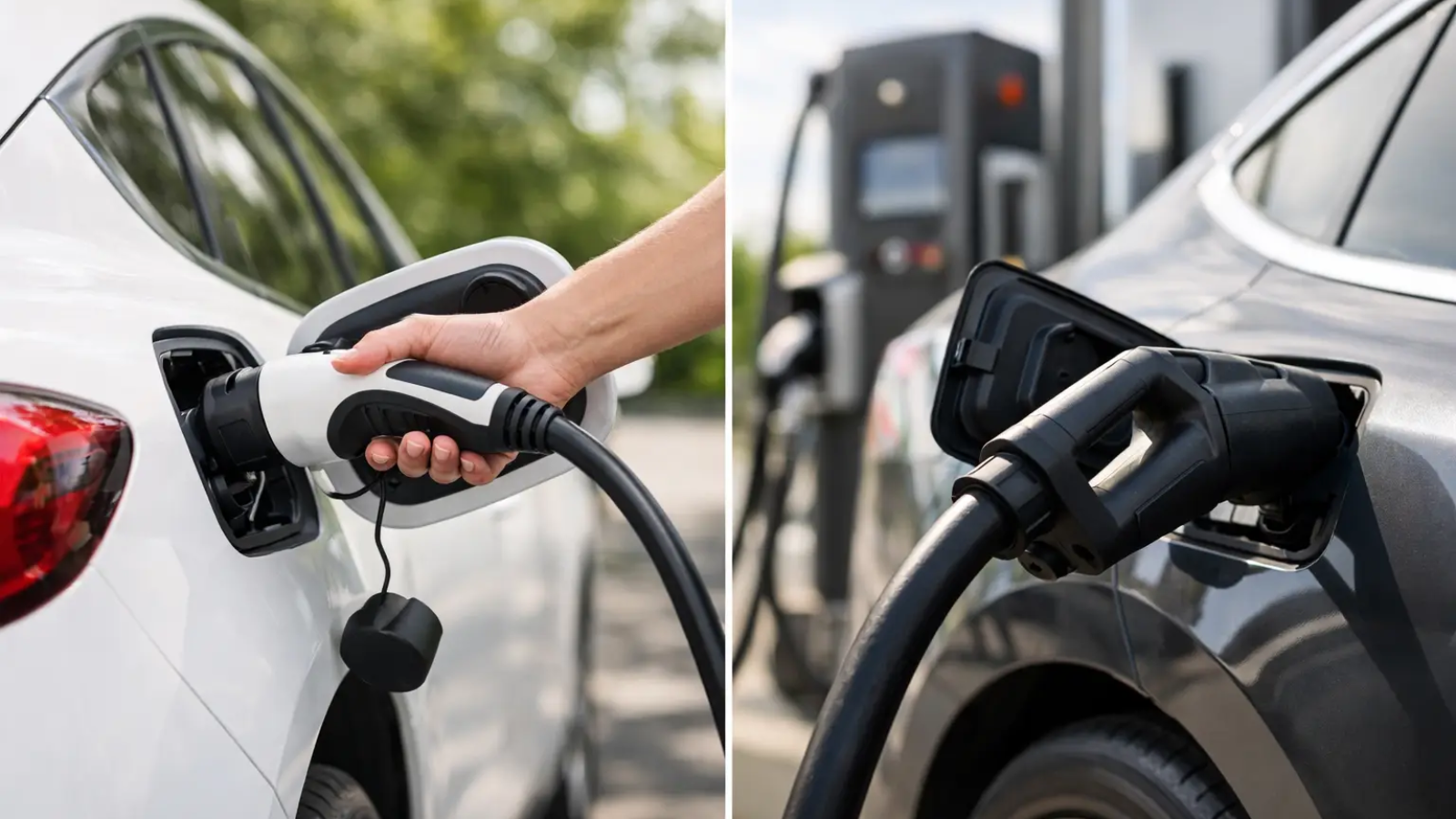
A 15-minute stop can add a meaningful amount of range at one charger and barely change the battery level at another. The difference comes down to AC charging vs DC charging – two approaches designed for very different driving patterns, properties, and budgets. Understanding where each fits helps EV owners and businesses invest in charging that works in real life, not just on a specification sheet.
AC Charging vs DC Charging: The Core Difference
Electric vehicles store energy in their batteries as direct current, or DC. The electricity supplied by the grid, and by most building electrical systems, is alternating current, or AC. An EV must convert AC electricity into DC before it can enter the battery.
With AC charging, that conversion happens inside the vehicle through its onboard charger. The charging station supplies AC power, while the car determines how much power it can accept. This is why two vehicles connected to the same Level 2 charger may charge at different speeds.
With DC charging, the conversion happens inside the charging equipment. The charger sends DC power directly to the battery, bypassing most of the vehicle’s onboard charging hardware. Because these chargers can deliver much higher power levels, they can replenish an EV battery far more quickly.
That distinction sounds technical, but it drives nearly every practical decision: charging speed, equipment cost, electrical requirements, site design, and the type of driver a charger can serve.
Why AC Charging Works So Well at Home and Work
AC charging is the standard choice where vehicles park for hours. In the United States, Level 1 and Level 2 charging are AC options. Level 1 uses a standard household outlet and is generally best for low-mileage drivers, plug-in hybrids, or occasional backup charging. It is slow, but it requires little infrastructure.
Level 2 charging uses a dedicated 240-volt circuit and is the everyday solution for most homeowners. Depending on the vehicle, charger, and electrical capacity, it commonly adds roughly 20 to 40 miles of range per hour. An overnight session can comfortably restore the energy used during a typical day of driving.
For workplaces, multifamily properties, hotels, and destination retail, Level 2 also makes strong operational sense. A driver who stays for several hours does not need ultra-fast charging. Providing steady charging over the duration of a workday, dinner, appointment, or overnight stay can be more useful than paying for high-power equipment that sits underused.
The vehicle sets part of the limit
A Level 2 charger may be rated for 48 amps, but the vehicle’s onboard charger has its own maximum AC acceptance rate. Some EVs may accept around 7.2 kW, while others can accept 11.5 kW or more. Installing a higher-capacity AC charger can still support future vehicle choices, but it will not force a car to charge faster than its design allows.
For homeowners, this is a useful reminder: bigger is not automatically better. The right charger is one that fits the household’s daily driving, electrical panel capacity, and available charging window.
AC charging pairs naturally with solar
AC charging can also complement a solar energy strategy. Solar production is highest during daylight hours, making workplace, commercial, and home daytime charging an opportunity to use more locally generated renewable electricity. A home EV charger does not need to receive power directly from solar panels to support this goal. When charging is timed for periods of strong solar output, the property can use more of its own solar generation before drawing additional power from the grid.
Smart scheduling matters here. Time-of-use electricity plans, solar production patterns, battery storage, and household loads can all affect the most economical time to charge.
When DC Fast Charging Is the Better Choice
DC fast charging is built for time-sensitive charging. It is the familiar option at highway corridors, major travel routes, fleet depots with tight turnaround times, and high-traffic public locations where drivers may stop for 20 to 45 minutes rather than several hours.
Power levels vary widely. A DC fast charger may deliver 50 kW, 150 kW, 350 kW, or more, although a vehicle will only take the power it can safely accept. Battery temperature, state of charge, battery chemistry, and the vehicle’s charging curve all influence the actual result.
The highest charging speeds usually occur when the battery is at a lower state of charge. As the battery fills, the vehicle reduces power to protect battery health. That is why charging from 10% to 80% is often much faster than charging from 80% to 100%, even at the same station.
For drivers on long trips, this is a feature rather than a flaw. The practical goal is often to add enough range to reach the next stop, not to wait for a full battery at every charger.
Faster charging requires more infrastructure
DC fast charging equipment costs more than AC equipment, and installation can be significantly more complex. A site may need substantial electrical capacity, upgraded switchgear, utility coordination, civil work, networking, and ongoing maintenance planning. Demand charges can also influence operating costs for commercial sites, depending on the local utility rate structure.
Those costs are justified when the site has a clear need for rapid turnover. A busy public charging location, a delivery fleet, or a travel-focused retail site may benefit from helping more vehicles charge in less time. At a small office where cars remain parked all day, DC fast charging may be an expensive mismatch.
Choosing the Right Charging Strategy for Your Property
The best charging choice begins with a simple question: how long do vehicles typically stay parked? The answer is more valuable than comparing maximum kilowatt ratings alone.
A homeowner who drives 35 miles per day usually benefits from Level 2 AC charging overnight. A multifamily property may need several shared Level 2 ports so residents can charge while they sleep. An office may prioritize managed AC charging that balances energy use across many employees’ vehicles. A highway-adjacent business may need DC fast charging because visitors expect to continue their trip quickly.
Commercial properties should also consider whether charging is an amenity, a revenue source, a fleet requirement, or a sustainability initiative. Each objective changes the right mix of equipment. For example, a shopping center might combine Level 2 chargers for employees with DC fast chargers for short-stay customers. A fleet depot may use lower-cost overnight AC charging for most vehicles and reserve DC charging for exceptions.
Plan for electrical capacity before selecting hardware
The available electrical service is often the deciding factor. A site assessment should review panel capacity, load patterns, distance from the electrical source, parking layout, and potential future expansion. It is usually less disruptive and more cost-effective to plan conduit, space, and electrical pathways for future chargers during the first installation.
Load management can be especially valuable. Smart charging systems can distribute available power across multiple vehicles rather than requiring every charger to operate at its maximum rating at the same time. This can allow a property to add more charging ports without immediately making major service upgrades.
Speed, Cost, and Battery Care: Finding the Balance
DC fast charging is not inherently harmful to an EV battery. Modern vehicles actively manage temperature and charging rates to protect battery life. Still, frequent high-power charging can create more heat and stress than slower charging, particularly in very hot or cold conditions. For most drivers, AC charging is the gentler, lower-cost default for routine use, while DC fast charging is a valuable tool for travel and time-sensitive days.
Cost also depends on more than the posted electricity rate. Home AC charging is often the least expensive option because it uses existing parking time and can be scheduled for lower-cost utility periods. Public DC fast charging provides speed and convenience, but those benefits are reflected in equipment, site, maintenance, and energy costs.
For businesses, the comparison should include utilization. A high-powered charger that serves only a few vehicles per day may not deliver the value of several well-placed Level 2 chargers. The right investment matches charging capacity to real demand, then leaves room for EV adoption to grow.
Build for the Way People Actually Drive
AC and DC charging are not competing technologies with one universal winner. They are complementary parts of a practical charging ecosystem. AC makes daily charging easy where vehicles already spend time. DC keeps longer journeys, urgent stops, and demanding fleet schedules moving.
The strongest charging plans begin with everyday behavior: where people park, how far they drive, when energy costs are lowest, and how renewable energy can play a larger role. By matching charging speed to the time a vehicle truly has available, homes and businesses can make every kilowatt work harder for cleaner transportation.
Add a Comment