
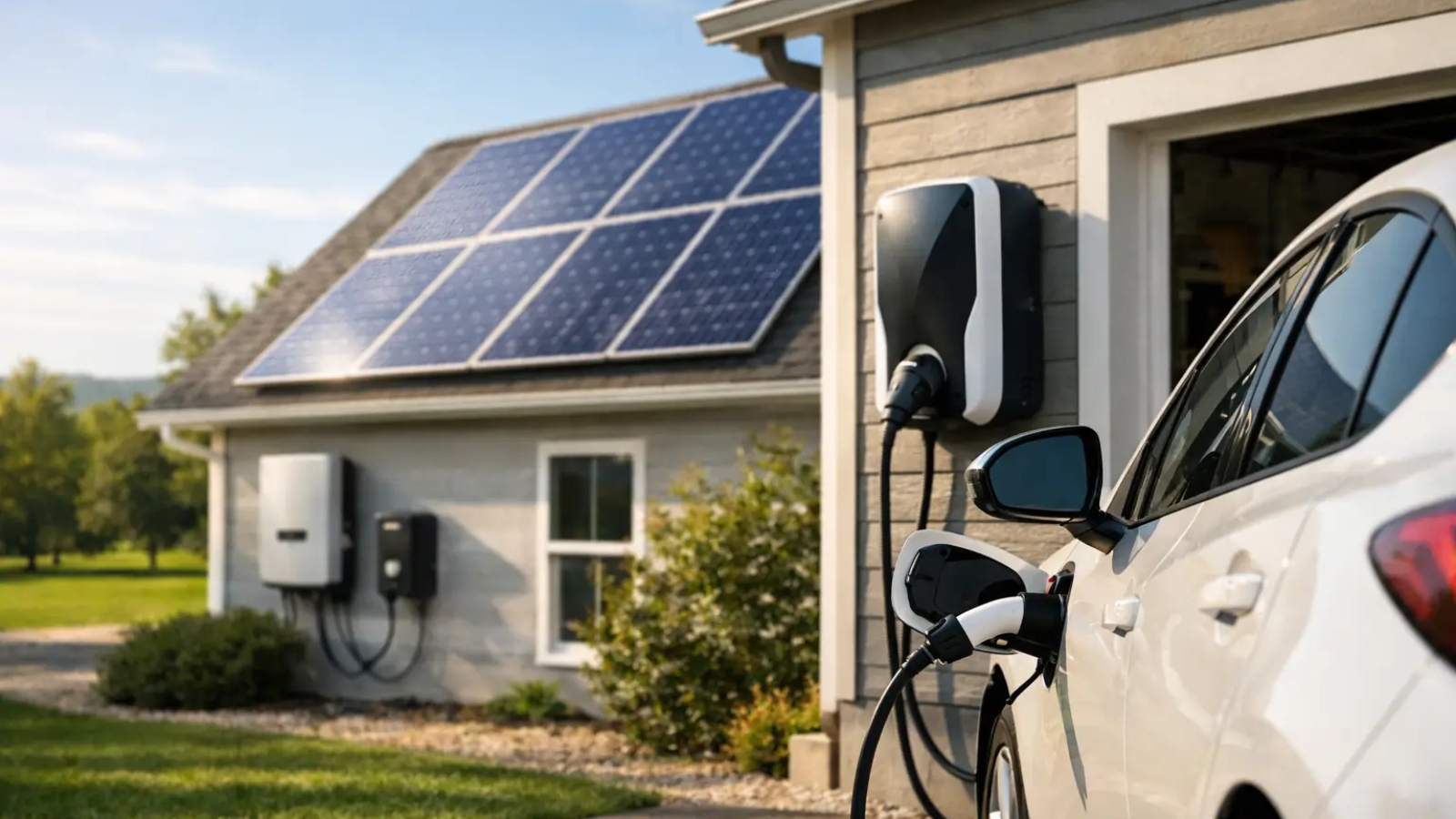
A home EV charger can add as much electricity demand as a major household appliance – but it can also become one of the most useful ways to consume solar energy. The best solar powered EV charger setups do not simply connect panels to a charger. They match a property’s solar output, driving habits, electrical capacity, and budget so clean power is used when it is available.
For most households, the goal is not to charge a vehicle directly from rooftop panels every minute of the day. Solar production rises and falls with weather and daylight, while EV charging needs to be safe, reliable, and convenient. A well-designed system uses the grid intelligently, prioritizes surplus solar when possible, and gives the driver confidence that the vehicle will be ready when needed.
What Makes a Solar EV Charging Setup Work
A solar EV charging system has three core parts: a solar array, an inverter that converts solar power into usable electricity, and a Level 2 EV charger connected to the home’s electrical panel. The charger draws power from the property, while the solar system offsets some or all of that demand over time.
The most practical setups add smart controls. A solar-aware charger or energy management platform can monitor household consumption and solar generation, then adjust charging speed to use excess generation. If the home is running air conditioning, cooking appliances, or a pool pump, the system can reduce EV charging to avoid importing more grid electricity than intended.
This distinction matters. A standard charger paired with solar still reduces annual energy costs, especially if the solar array is sized for the home’s total electricity use. A smart charger adds the ability to align charging more closely with sunny hours, which can increase self-consumption of the solar energy produced on-site.
Best Solar Powered EV Charger Setups by Need
There is no single best design for every driver. The right choice depends primarily on when the vehicle is parked, how far it travels, and whether the property already has solar.
1. Grid-connected solar with a smart Level 2 charger
For most homeowners, this is the strongest starting point. The property remains connected to the utility grid, rooftop solar lowers net electricity purchases, and a smart Level 2 charger uses available solar surplus whenever practical.
This approach works particularly well for remote workers, households with a car at home during the day, and drivers whose vehicles can remain plugged in for several hours. A typical Level 2 charger can provide roughly 20 to 40 miles of range per hour, depending on the vehicle and charging power. Smart controls can slow charging when solar output is modest and increase it as production rises.
The trade-off is timing. If the car is away all day and returns after sunset, solar-aware charging offers less immediate benefit. The solar array still helps offset overall household electricity use, but the EV may charge mostly from the grid at night.
2. Solar plus home battery plus EV charging
Adding battery storage gives a household more control over when solar energy is used. During the day, solar can serve home loads, charge the battery, and support the EV. Stored energy can then be used in the evening, during high utility-rate periods, or during an outage if the system is designed for backup power.
This can be a compelling setup for homeowners in areas with time-of-use utility rates, frequent outages, or limited net-metering value. It also suits drivers who arrive home in the evening and want more of their charging energy to originate from their own solar production.
However, batteries add meaningful cost. An EV battery is far larger than a typical home battery, so trying to fully recharge a depleted vehicle from home storage is usually not economical. The better strategy is to use the home battery for household resilience and rate management, while the solar system and grid handle the larger energy requirement of routine EV charging.
3. Oversized solar array with scheduled overnight charging
Not every solar EV setup needs solar-following controls or battery storage. In some markets, a larger rooftop system paired with scheduled overnight charging is a simple, effective choice. The solar array sends power to the home and grid during the day, while the charger operates during lower-cost overnight utility periods.
This setup can make sense where utility programs provide fair credit for exported solar electricity or where off-peak charging prices are significantly lower. It is easier to install and operate than a tightly integrated energy management system.
Its limitation is that it does not maximize direct solar charging. Instead, it treats solar production and EV charging as part of the home’s total annual energy balance. For many households, that is enough.
4. Solar carport charging for businesses and multifamily properties
For workplaces, retail sites, apartment communities, and fleet depots, solar carports can combine shaded parking, visible clean-energy infrastructure, and EV charging in one asset. Because vehicles are often parked during daylight hours, commercial sites may be better positioned than homes to use solar generation directly.
The design process is more involved. A business must consider parking turnover, charger utilization, peak demand charges, electrical service capacity, and future expansion. Load management is especially valuable: it allows multiple chargers to share available power without requiring every port to operate at maximum output simultaneously.
A solar carport is not automatically the lowest-cost option. Structural work, permitting, and site conditions can raise project costs compared with rooftop solar. But where roof space is limited or covered parking has value, it can be a highly visible and practical long-term investment.
Size the System Around Energy, Not Just Charger Speed
A common mistake is selecting an EV charger first and sizing everything else around its maximum power. A 48-amp Level 2 charger may be a good fit for fast home charging, but it does not mean the solar array must continuously produce that amount of power.
Start with driving. If an EV travels 12,000 miles annually and averages 3.5 miles per kilowatt-hour, it will require about 3,430 kWh of electricity per year before charging losses. Add roughly 10% for those losses, and the annual charging requirement is closer to 3,775 kWh.
Then look at local solar production. In a sunny location, each kilowatt of solar capacity may generate around 1,400 to 1,700 kWh per year. In less sunny areas, it may produce considerably less. This means the EV portion of a solar system might require roughly 2.5 to 3 kW of additional solar capacity in one region and more in another.
That calculation is only a starting point. A property should also account for existing electricity use, roof orientation, shading, future appliances such as heat pumps, and whether a second EV is likely. Designing for a realistic five- to 10-year energy plan can prevent costly upgrades later.
Electrical Capacity and Installation Details Matter
A solar system does not eliminate the need for a proper charger installation. The electrical panel must have enough capacity for the added continuous load, and local code requirements determine circuit sizing, disconnects, wiring methods, and permit requirements.
In some homes, a service upgrade is necessary before installing a high-power charger. In others, dynamic load management can avoid that expense by automatically reducing charging when the home approaches its service limit. This is often an attractive option for older homes or properties with electric cooking, air conditioning, and other high-demand equipment.
Charger location deserves careful thought as well. A garage installation is usually straightforward, while a driveway or detached parking area may require trenching, weather-rated equipment, and longer cable runs. Choosing a charger with app scheduling, access controls, and energy monitoring can make the system easier to manage after installation.
Questions to Ask Before Choosing Equipment
The best equipment decisions come after a clear picture of energy use and daily routines. Before moving forward, homeowners and site managers should be able to answer these questions:
- Is the vehicle normally parked during the hours when solar produces the most energy?
- Does the property have enough solar capacity for present and future driving needs?
- Are utility rates based on time of use, and how is exported solar electricity credited?
- Can the existing electrical service support the charger, or would load management provide a better path?
- Is resilience during outages a priority, or is the main goal lower charging costs and emissions?
These answers often reveal that the most expensive configuration is not necessarily the most effective one. A smart Level 2 charger and correctly sized solar array may outperform a battery-heavy design for one household, while a battery and backup-capable system may be justified for another.
A Cleaner Charge Starts With a Smarter Plan
Solar-powered EV charging is most valuable when it is treated as part of a broader property energy strategy, not as a standalone gadget. The right setup can reduce operating costs, increase the value of solar generation, and make everyday driving meaningfully cleaner. Charge & Go helps customers approach that decision with the practical perspective it deserves: start with how energy is produced, used, and needed, then build a charging system that can keep pace with the road ahead.
Add a Comment