
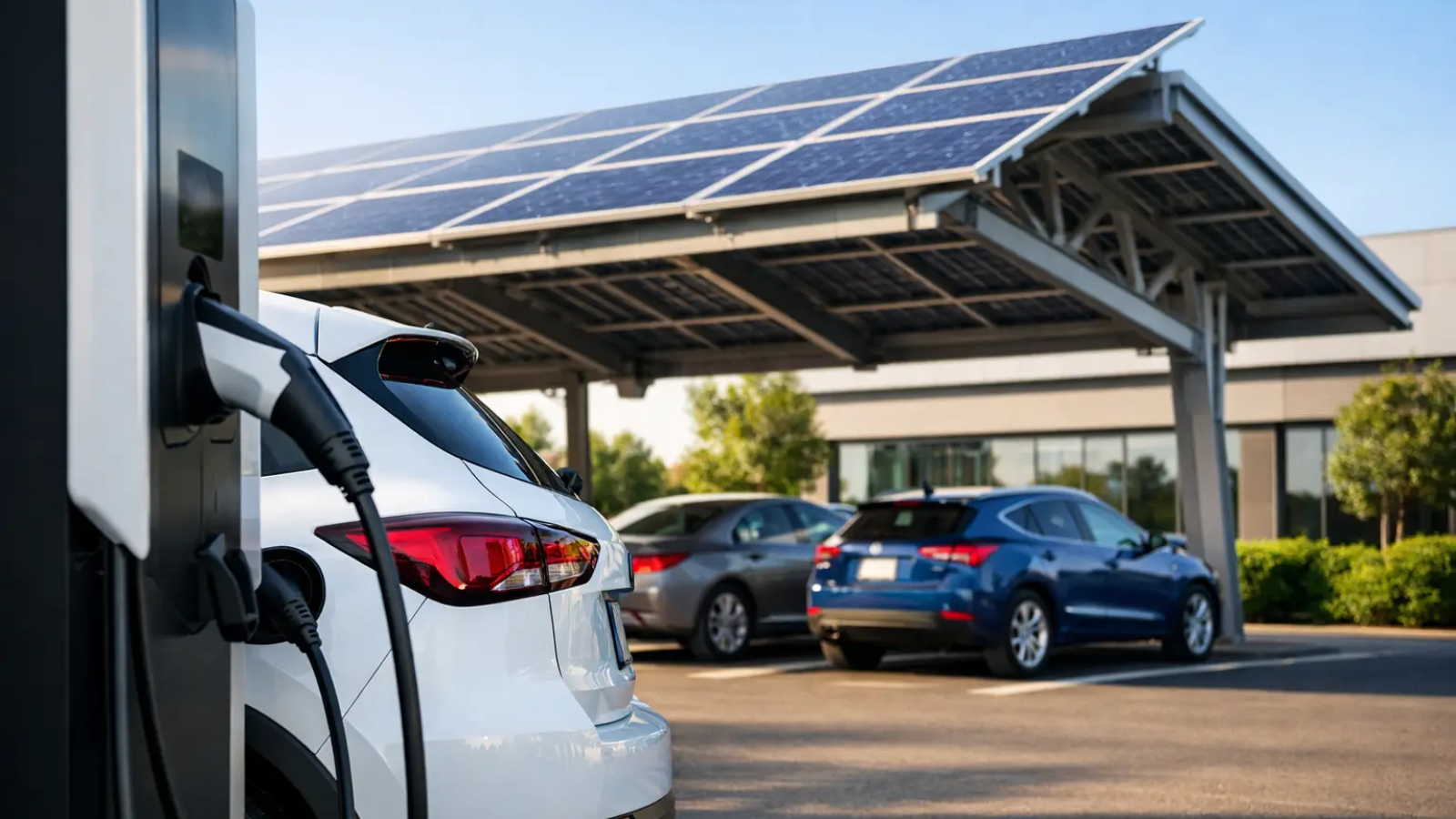
A parking lot can be one of the least productive parts of a property. It absorbs heat, offers little protection from weather, and often represents a major unused surface area. Solar carport benefits change that equation by turning parking spaces into an on-site energy asset while improving the experience for drivers, tenants, employees, and customers.
For homeowners with limited roof space, a solar carport can create room for a larger system without changing the house. For businesses, multifamily properties, schools, and retail sites, it can connect clean electricity generation with a highly visible amenity: shaded parking and EV charging. The right project is not simply a set of panels above cars. It is a piece of energy infrastructure that needs to fit how the property operates.
1. Put Existing Parking Space to Work
The core value of a solar carport is simple: it generates electricity without requiring new land or relying entirely on roof space. This matters on properties where roofs are too small, shaded by nearby buildings or trees, structurally unsuitable, or already occupied by equipment.
A carport uses the open area above parking stalls, drive lanes, or fleet parking. It can help a property owner add solar capacity while preserving the existing use of the site below. That dual use is especially useful in dense locations where every square foot has a purpose.
Solar carports are also flexible in scale. A homeowner may cover one or two vehicles. A commercial site may build a multi-row canopy designed around peak electricity demand, available parking, and future charging plans. The physical layout should support safe circulation, accessible parking requirements, drainage, and clear sightlines, not just maximize panel count.
2. Lower Exposure to Utility Energy Costs
On-site solar generation can reduce the electricity a property needs to buy from the grid during daylight hours. When paired with a billing structure that rewards self-consumption, that can create meaningful long-term savings. The exact financial outcome depends on local utility rates, system size, sunlight, demand charges, incentives, financing, and how much of the solar power is used when it is produced.
That last point deserves attention. A solar carport performs best financially when its output aligns with daytime demand. Offices, retail locations, warehouses, schools, and multifamily common areas may have consistent daytime loads that can use solar electricity directly. If an EV charging program is added, charging schedules can further increase on-site consumption.
For some commercial properties, reducing peak demand can be as valuable as reducing total energy purchases. Smart chargers, energy management controls, and battery storage can help manage when power is drawn from the grid. Storage is not essential for every project, but it can be worth evaluating where demand charges are high, grid reliability is a concern, or charging needs continue after sunset.
3. Make EV Charging More Practical
EV charging and solar carports are a natural match because vehicles are frequently parked during the day, when solar generation is strongest. A workplace can support employee charging while generating part of the electricity on-site. A retail destination can offer a useful amenity to customers. A fleet operator can create a more predictable energy strategy for vehicles that return to a central location.
It is important, however, to describe this accurately. Solar panels do not usually send power directly from one parking-space canopy into one vehicle at every moment. Most systems are connected through the building’s electrical infrastructure and, depending on the design, the utility grid. The solar production offsets site electricity use, while the chargers draw power through the managed electrical system.
This integrated approach is still powerful. It allows a property to coordinate solar production, building loads, charger usage, and potentially batteries. Load management can prevent several vehicles from charging at full power simultaneously when the site has limited electrical capacity. That may reduce costly electrical upgrades and make a phased rollout of chargers more realistic.
4. Improve the Parking Experience
The most immediate benefit is one drivers notice before seeing an energy bill: shade. Covered parking can keep vehicle cabins cooler, reduce sun exposure on interiors, and offer protection from rain, snow, and falling debris. In hot climates, a cooler vehicle may also reduce the air-conditioning load needed when a driver starts the trip.
For employers and property managers, this is more than a cosmetic improvement. Better parking can support tenant satisfaction, employee retention, customer dwell time, and a stronger perception of the property. When EV chargers are installed beneath the canopy, the space becomes an amenity that signals the site is prepared for changing transportation needs.
Lighting can be integrated into the structure as well, improving visibility and comfort after dark. Good design matters here. Columns, lighting placement, canopy height, signage, and charger locations must work together so the area feels safe and easy to navigate.
5. Advance Visible Sustainability Goals
Many organizations have clean-energy, emissions-reduction, or ESG commitments. A solar carport gives those commitments a physical presence on the property. Unlike a behind-the-scenes efficiency upgrade, it is visible to employees, visitors, residents, and customers every day.
Visibility should not replace measurement. A credible project starts with projected solar production, expected energy use, and a clear plan for monitoring performance. After installation, owners can track generation and compare it with building consumption and charging activity. This creates useful data for sustainability reporting and future infrastructure decisions.
For businesses with public-facing brands, the canopy can also make the transition to cleaner energy easier to understand. It connects an abstract goal, such as reducing operational emissions, with a practical benefit: the parking area is producing power for the site and supporting electric transportation.
6. Prepare for Future Energy Needs
Electrical demand is changing. More drivers are adopting EVs, fleets are beginning to electrify, and properties are adding heat pumps and other electric equipment. A solar carport can be designed as part of a longer-term energy plan rather than a one-time construction project.
That does not mean every site should install the maximum possible number of chargers on day one. A more practical approach may be to prepare conduit, electrical capacity, and parking locations for future expansion while installing chargers that match current demand. This avoids unnecessary upfront cost while making growth less disruptive later.
The same principle applies to solar capacity. A feasibility assessment should examine utility interconnection limits, electrical panels, transformer capacity, roof and site conditions, parking patterns, and planned building changes. A well-designed system leaves room to adapt instead of forcing the owner into another major redesign within a few years.
7. Strengthen Property Value and Resilience
A solar carport can make a property more competitive, particularly where covered parking, EV charging, and energy efficiency matter to tenants or customers. The precise effect on property value varies by market and property type, so it should not be treated as guaranteed. Still, infrastructure that lowers operating costs, improves amenities, and supports future electrification can strengthen a site’s overall appeal.
Resilience is another consideration. Solar panels alone generally do not keep a building powered during a grid outage. For backup capability, the system needs appropriate inverters, controls, and usually battery storage or other backup equipment. When resilience is a priority, the project should identify which loads matter most, such as critical lighting, communications, refrigeration, or fleet charging, and size the backup strategy accordingly.
What to Evaluate Before Building a Solar Carport
Solar carports involve more construction complexity than a typical rooftop solar system. Foundations, steel structures, stormwater flow, parking operations, permitting, utility interconnection, and electrical upgrades can all affect cost and timeline. The project should begin with a site assessment, not a panel-count estimate.
Start by looking at parking usage. Are spaces occupied during the day? Is the lot likely to be repaved soon? Will construction disrupt customers, residents, or fleet operations? Then evaluate energy data, including interval usage if available, to understand when the property consumes electricity and whether EV charging will change that profile.
It is also wise to compare the carport against alternatives. A rooftop system may be less expensive when the roof is suitable. Ground-mounted solar may work where land is available. A carport often becomes the stronger option when parking coverage, EV charging, limited roof capacity, or site visibility adds value beyond electricity production.
The best solar carport is not the largest one a site can physically hold. It is the one that fits the property’s energy use, budget, parking needs, and long-term mobility plans. With thoughtful design, the spaces where vehicles wait can become a practical foundation for cleaner power and more confident EV adoption.
Add a Comment