
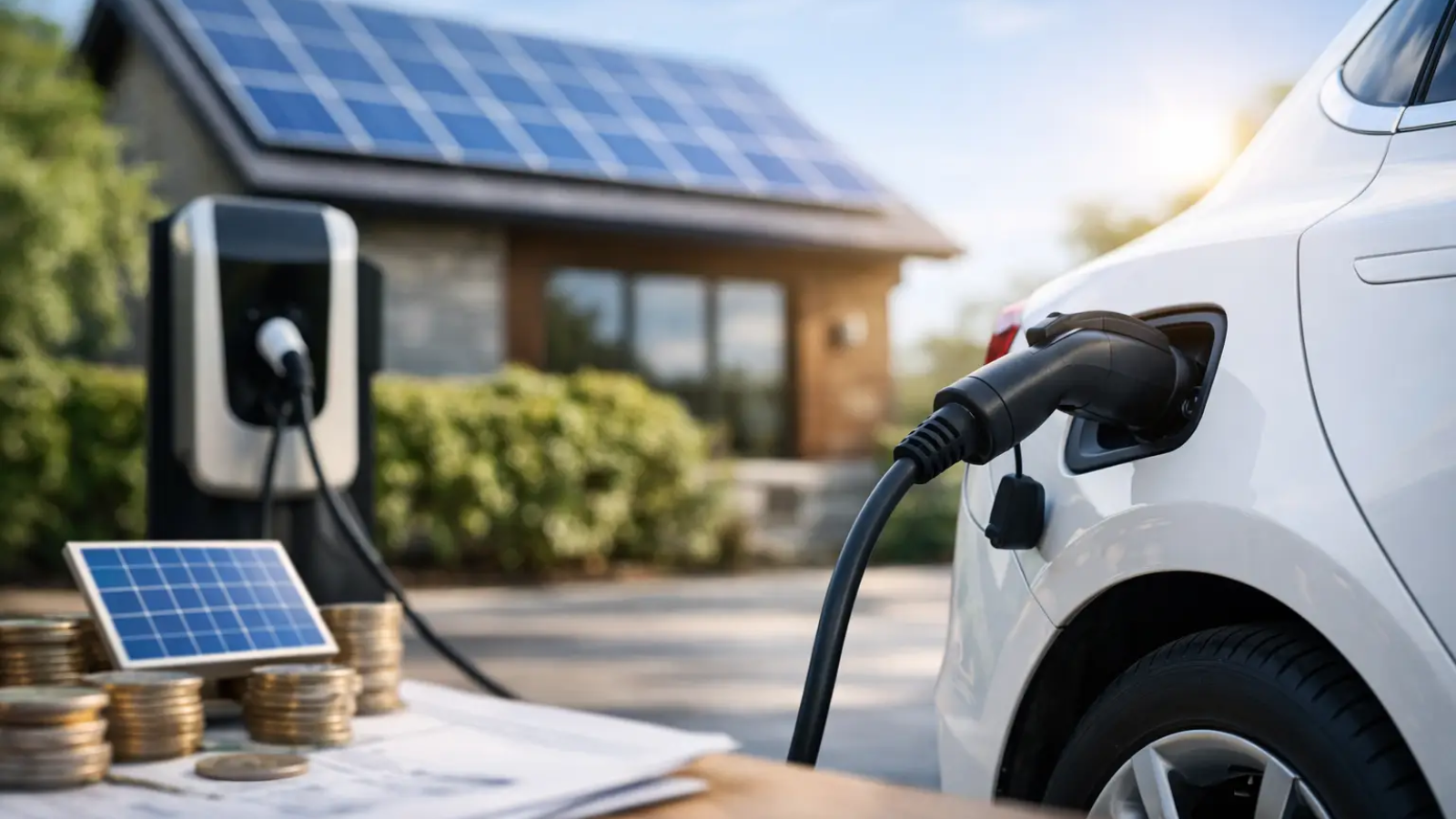
An EV that charges in your driveway can turn a monthly fuel expense into a line item you can actively manage. But will solar reduce charging bills? In many homes and businesses, yes – sometimes substantially. The size of the savings depends less on simply having panels and more on when your vehicle charges, how your utility prices electricity, and how the solar system is designed.
Solar is not a magic source of free driving. Panels produce power during daylight, while many EVs are plugged in overnight. The opportunity lies in aligning those two patterns as closely as possible, or using your utility’s billing rules and, where appropriate, battery storage to make solar generation work harder for your charging needs.
How solar reduces EV charging costs
A solar system produces electricity that can serve loads at the property before electricity is purchased from the grid. If an EV is charging while the panels are generating, solar power can directly offset some or all of the electricity that charging session would otherwise draw from the utility.
Consider a vehicle that uses about 30 kWh to travel 100 miles. At a home electricity rate of $0.20 per kWh, that energy costs roughly $6 from the grid. If solar covers the energy used for that charge, the avoided utility cost is close to that $6, subject to the way the utility measures and bills exported solar production.
For a business, the calculation can be more significant. Workplace, fleet, multifamily, and destination chargers may operate most heavily during the day, which often overlaps naturally with solar output. A well-planned solar and charging installation can reduce purchased electricity while supporting a visible sustainability commitment for employees, tenants, or customers.
The important distinction is that solar can reduce the electricity bill associated with charging. It does not necessarily eliminate it every month. Cloud cover, seasonal production, vehicle mileage, charging time, and utility rules all affect the result.
Will solar reduce charging bills if you charge at night?
Yes, it can, but the answer becomes more dependent on your utility plan. Solar panels generally produce little or no power after sunset, so overnight charging is not usually powered directly by rooftop solar unless the property has a battery.
That does not mean daytime solar has no value. Under net metering or similar export-credit programs, excess solar generated during the day may earn credits that offset electricity consumed at night. The value of those credits differs widely. Some utilities credit exported energy near the retail electricity rate, while others pay a lower rate. A lower export rate makes it more valuable to use solar power on-site while it is being generated.
Time-of-use rates add another layer. In some areas, electricity is cheaper overnight, making scheduled nighttime charging economical even without a battery. In others, late-afternoon and evening rates are high, and a home battery can store midday solar for use during more expensive periods. The best schedule is not always “charge whenever the sun is shining.” It is the schedule that balances solar production, electricity prices, vehicle availability, and your household’s other energy needs.
Smart EV chargers make this easier. Many allow owners to set charging windows, delay charging until solar production is available, or cap charging during periods of high demand. For drivers who work from home or have a vehicle parked during the day, solar-aware charging can increase the share of driving energy supplied directly from the roof.
The factors that determine your savings
A solar estimate should start with driving, not just roof space. Annual mileage and vehicle efficiency determine how much energy charging requires. Someone driving 12,000 miles a year in an EV that averages 3.5 miles per kWh will need roughly 3,400 kWh annually before charging losses. That is a meaningful new electrical load, but it may still be smaller than a home’s air conditioning or electric heating demand.
Four factors have the greatest influence on the outcome:
- Solar system production: Panel orientation, shading, local weather, and system size determine how many kilowatt-hours the system produces across the year.
- Charging behavior: Daytime, overnight, weekend, and workplace charging patterns determine how much solar energy can be used directly.
- Utility rate design: Flat rates, time-of-use pricing, demand charges, and solar export compensation can change the financial value of each kilowatt-hour.
- Battery storage and controls: Batteries and intelligent charging controls can improve solar self-consumption, though their added cost must be weighed against the expected benefit.
For commercial properties, demand charges deserve special attention. A bank of chargers that starts at the same time can create a high short-term power peak, even if total energy use is reasonable. Solar may reduce the building’s daytime grid draw, but it may not fully prevent demand charges if charging load peaks when solar output is low. Load management, which shares available power among chargers, is often as important as the panels themselves.
Size solar for the property, then account for the EV
It is tempting to size a system solely around the vehicle. In practice, a better approach is to examine the entire property’s annual electricity use, current rate plan, and expected changes over the next several years. An EV may be the first new electric load, but a heat pump, induction cooking, or additional vehicles may follow.
A system that is too small may offset only a modest portion of charging and household consumption. A system that is oversized can produce more electricity than the property can use or receive favorable credit for, depending on local rules. The goal is not the largest possible array. It is a system designed around useful production and a realistic energy plan.
For homeowners, reviewing at least 12 months of utility bills creates a more reliable baseline. Add estimated EV charging needs, then consider whether charging will primarily happen at home, at work, or at public stations. If a driver relies heavily on workplace charging, a large home solar increase may not produce the expected transportation savings.
For businesses, the analysis should include building load profiles, operating hours, anticipated charger utilization, parking dwell times, and future fleet plans. A retail site with midday customer traffic has a different solar-charging opportunity than an apartment building where residents plug in after work.
When a battery makes sense
A battery can store excess solar generation for later use, including evening EV charging. That makes it appealing, but it is not automatically the most cost-effective first step. If your utility provides strong credits for exported solar and offers low overnight charging rates, a battery may offer limited bill savings compared with its upfront cost.
Battery storage becomes more compelling when export compensation is low, evening rates are high, backup power matters, or the property needs to control peak demand. It can also help owners use more of their own solar energy rather than sending it to the grid. Still, batteries have capacity limits. Charging a large EV battery can consume stored energy quickly, so the system should be designed around priorities such as backup loads, evening household use, or transportation.
For many properties, smart charging is the lower-cost first move. Scheduling, load balancing, and solar-responsive controls can capture a meaningful share of the benefit without adding storage immediately.
Plan for savings you can measure
The strongest solar and EV charging projects begin with data. Track how many miles you drive, how much electricity your EV uses, and when it is plugged in. Compare that information with your solar production and utility rate periods after installation. This turns an appealing clean-energy idea into a system you can actively optimize.
Charge & Go approaches solar and electric mobility as connected decisions: the charger, the property’s energy use, and the way electricity is billed should work together. A qualified assessment can identify whether daytime charging, managed overnight charging, additional solar capacity, or storage offers the most practical path.
The useful question is not whether solar makes every mile free. It is how much of your driving energy can be produced, timed, and managed on your terms – while making the property cleaner and more resilient over time.
Add a Comment