
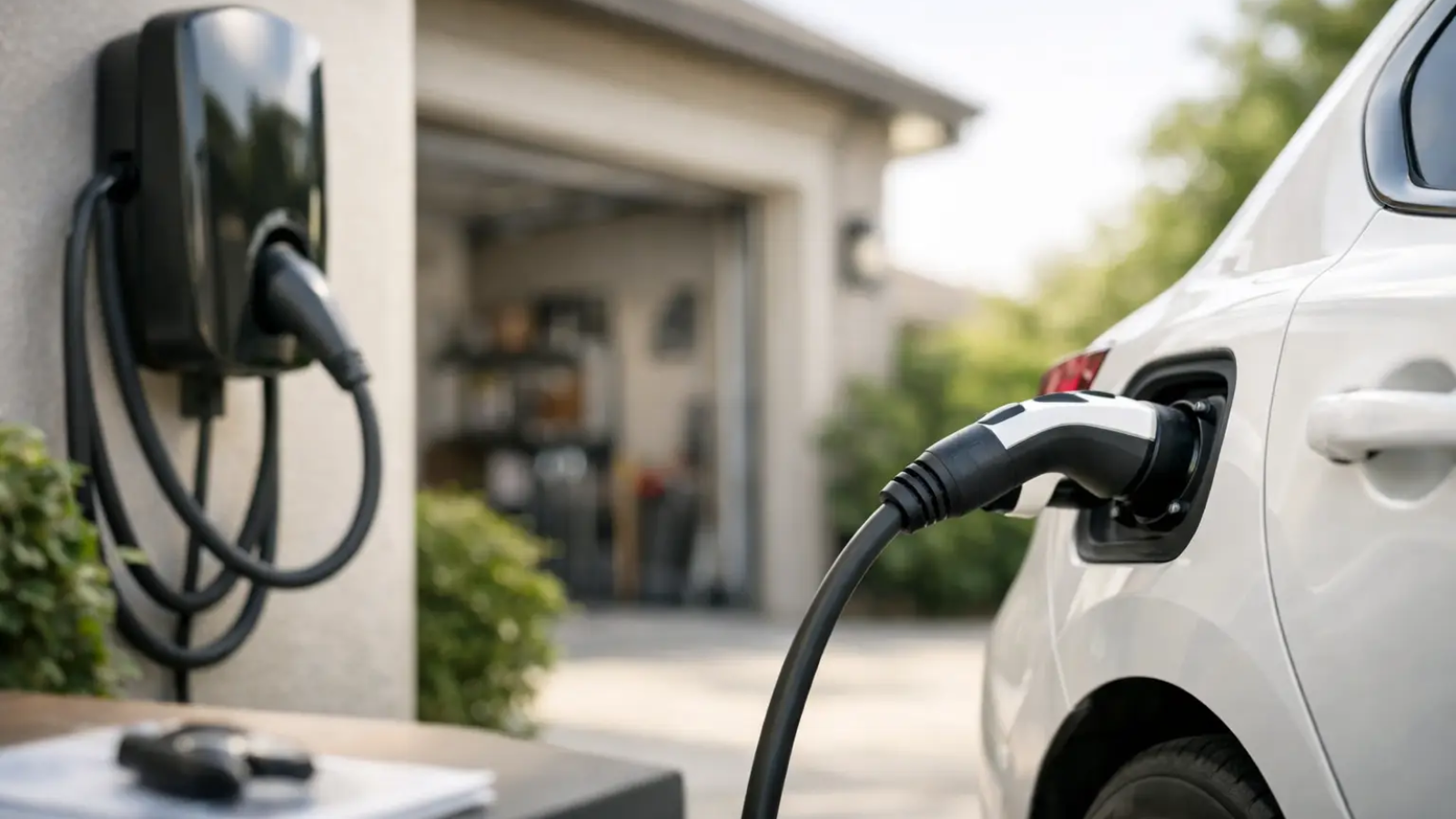
Most EV charging happens while the vehicle is parked, not while it is on the road. That makes the charger at home one of the most consequential parts of EV ownership: it shapes your daily convenience, your electricity use, and your ability to make the most of cleaner energy. This home EV charger buyer guide focuses on the decisions that matter before equipment is ordered or an electrician arrives.
The right choice is rarely the charger with the highest advertised power. It is the charger that fits your vehicle, electrical panel, parking arrangement, driving habits, and longer-term plans for solar or a second EV.
Start with the charging speed you actually need
For most homes, a Level 2 charger is the practical standard. It uses a 240-volt circuit and can add considerably more range per hour than a standard household outlet. Exact results depend on the vehicle, but Level 2 charging typically replenishes an everyday commute overnight with room to spare.
A Level 1 charger, which plugs into a standard 120-volt outlet, can work for drivers with short daily mileage and dependable overnight parking. It is a lower-cost starting point, but it may feel limiting for larger battery vehicles, frequent drivers, or households that share one charging point. It is also less forgiving when a late arrival is followed by an early departure.
Level 2 chargers are commonly rated from 16 to 80 amps. More amps can mean faster charging, but only when both the vehicle and the home can support it. Many EVs accept 32 to 48 amps at home, and that is more than sufficient for typical overnight charging. Choosing an 80-amp unit for a vehicle that cannot use that capacity may add installation expense without improving your routine.
Think about the weekly pattern rather than the occasional road trip. If you drive 35 miles most days, you do not need to replace an entire battery every night. A properly sized Level 2 charger should restore what you use with time to spare, without forcing unnecessary electrical upgrades.
Check your vehicle connector and charging limits
In the United States, most new EVs use either the J1772 connector or the North American Charging Standard, often called NACS. Tesla vehicles have long used NACS, while more automakers are adopting it. Some vehicles can use adapters, but it is still worth choosing a charger and connector arrangement that is simple for your household.
The connector is only one part of compatibility. Your EV also has an onboard charger that sets the maximum AC charging rate it can accept. A 48-amp charger cannot make a vehicle that accepts 32 amps charge at 48 amps. Review your vehicle manual or specifications before paying for capacity you cannot use.
If you expect to change vehicles in the next few years, flexibility matters. A charger with a widely supported connector, a practical cable length, and a manufacturer-supported adapter strategy can make the installation more future-ready.
Plan the electrical installation before choosing hardware
A home EV charger is an electrical project first and a product purchase second. The installation determines safety, available charging capacity, and a large share of the total cost.
A licensed electrician should assess the main electrical panel, available capacity, route from the panel to the parking space, grounding, and local code requirements. A charger may require a dedicated circuit and, depending on the unit and local rules, specific protective devices. Older homes or homes with already-heavy loads from electric cooking, air conditioning, heat pumps, or pool equipment may need a load calculation before a new circuit is added.
Panel capacity is not a simple yes-or-no question. A home can have a 200-amp service and still require thoughtful load management, while another home with a smaller service may accommodate EV charging with the right settings. Smart load management can reduce or pause charging when the household approaches its electrical limit, potentially avoiding an expensive service upgrade.
Hardwired chargers are permanently connected to the circuit. They often support higher charging rates and create a tidy, durable setup. Plug-in units use a 240-volt receptacle, which can make replacement easier and provide some flexibility, but the outlet, plug, and circuit must be correctly rated for continuous charging. Do not treat a high-power EV charger like an appliance that can be connected to any available outlet.
Installation complexity can vary widely. A garage wall near the electrical panel is usually simpler than a detached garage, driveway pedestal, or parking space on the other side of a finished home. Get an installation assessment early, so charger pricing does not become the only number guiding the decision.
Choose smart features that serve a real purpose
Smart chargers connect to Wi-Fi, cellular service, or an app. The useful features are not about adding another screen to your life. They are about giving you better control over when and how your vehicle uses electricity.
Scheduling lets you charge during off-peak utility hours, when rates may be lower and grid demand is reduced. Energy monitoring shows how much electricity your vehicle uses, which is helpful for household budgeting, reimbursement, or understanding the impact of switching from gasoline. Remote status alerts can also confirm that charging started successfully before you turn in for the night.
For homes with multiple EVs, look for power sharing. This feature allows two chargers to divide available capacity rather than requiring a major upgrade to run both at maximum output. It is a practical investment for households expecting a second EV, even if only one is in the driveway today.
Connectivity has trade-offs. App-based controls are convenient, but a charger should remain safe and functional if Wi-Fi drops. Prioritize a trusted manufacturer, clear warranty coverage, software support, and physical controls that do not depend entirely on a phone.
Make solar readiness part of the decision
EV charging and solar energy are a natural match, but the best setup depends on when your vehicle is parked and how your utility bills electricity. Solar panels generate the most power during daylight hours, while many drivers are away at work. If your EV is home during the day, smart charging can help use more on-site solar production directly.
Even when daytime charging is not practical, solar can still lower the household energy cost associated with EV ownership. The value depends on local net-metering rules, time-of-use rates, battery storage, and your overall consumption. A home energy monitor or solar-aware charger can provide useful visibility, but do not assume every smart charger can automatically charge only from excess solar production. Confirm how the feature works in your specific system.
When planning solar and EV charging together, consider the whole home. A larger electrical panel, managed charging, home battery storage, and appliance electrification can all affect the final design. Coordinating these choices can prevent duplicated work and support a more efficient path to cleaner transportation.
Compare total cost, not just the charger price
The hardware cost is only one part of a home charging budget. Installation may include wiring, conduit, trenching, panel work, permits, inspections, and mounting equipment. A less expensive charger can become the costlier option if it requires a more demanding circuit or does not meet local requirements.
Ask installers for a clear scope of work. It should identify charger amperage, circuit size, wiring route, permits, equipment included, and any assumptions about the electrical panel. If a quote excludes possible panel upgrades or repairs, understand the conditions that could trigger those costs.
Utility programs, local incentives, and federal tax credits may help offset eligible equipment or installation expenses. These programs change and often have requirements related to location, installation date, product certification, or household eligibility. Treat incentives as a potential benefit, not the foundation of the budget, until you have verified the current rules.
Safety and durability deserve equal weight
A home charger handles significant electrical load for hours at a time. Look for equipment certified by a recognized safety testing organization and suitable for its intended environment. For an outdoor installation, choose a weather-rated unit and plan cable management that keeps the connector off the ground and out of standing water.
Cable length matters more than it seems. Measure the distance from the proposed charger location to your vehicle’s charge port, accounting for how the car is parked. Too short creates daily frustration; excessively long can be harder to store and protect. A cable holster or integrated management system keeps the charging area safer and more organized.
Also consider access. If the charger is visible from the street, shared with tenants, or installed in a multi-unit property, you may need access controls, billing functions, or a lockable design. A homeowner’s needs differ from those of a property manager, even when the equipment looks similar.
A better home EV charger buyer guide starts with your routine
Before selecting a model, write down your vehicle’s maximum AC charging rate, daily mileage, parking location, panel capacity, and plans for solar or another EV. Those five details will narrow the field more effectively than a long feature comparison.
A thoughtfully planned charger turns electricity into a quiet daily habit: arrive home, plug in, and wake up ready to go. It is a small piece of infrastructure with a meaningful role in lower-emission transportation and a more energy-aware home.
Add a Comment