
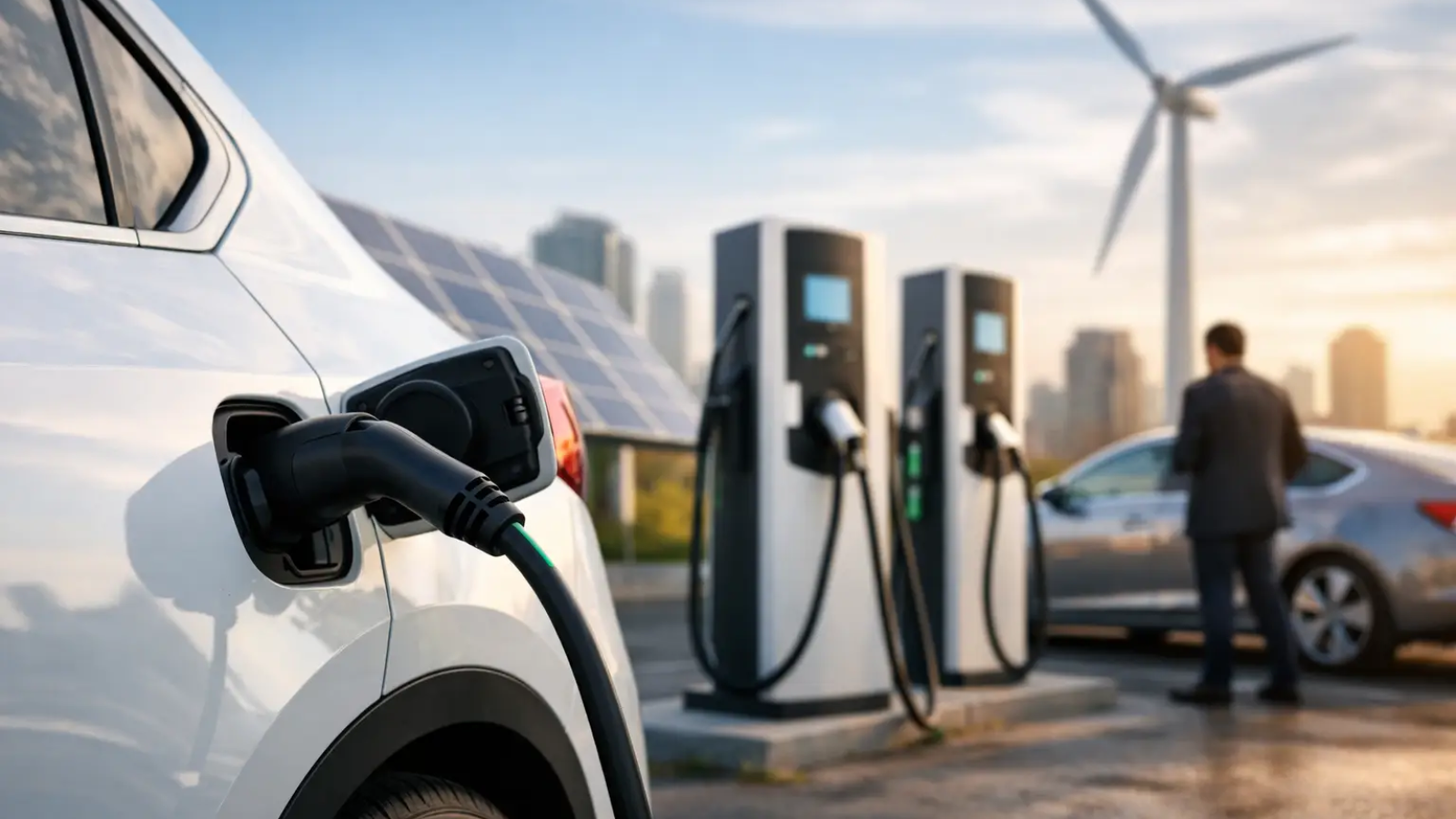
A year ago, many EV charging decisions were still framed around a simple question: how fast can this charger deliver power? In 2026, that question is still relevant, but it is no longer enough. EV charging trends 2026 are being shaped by a wider set of priorities – grid capacity, software visibility, site economics, user experience, and how well charging works alongside solar and battery storage.
That shift matters for homeowners, property managers, and business operators alike. The market is moving from early adoption to infrastructure planning. Charging is becoming less about installing a box on a wall and more about building an energy system that can adapt over time.
EV charging trends 2026 are becoming more site-specific
One of the clearest changes in 2026 is that there is no longer a single “best” charging setup. The right solution depends on where the charger is installed, how long vehicles stay parked, and what the broader energy profile looks like.
For homeowners, overnight charging still makes Level 2 the practical standard. The difference is that buyers are paying more attention to load management, app controls, and solar compatibility than they did a few years ago. A charger that can adjust charging around household demand or take advantage of lower energy rates now offers a real advantage.
For commercial properties, the conversation is more complex. Office buildings, mixed-use developments, retail sites, and logistics hubs all have different traffic patterns. A workplace charger serving employees for eight hours each day has very different economics from a public charger at a convenience site where drivers want a quick top-up. In 2026, charging strategy is increasingly defined by dwell time, not just connector type or power rating.
Faster charging is still advancing, but speed is not the whole story
Ultra-fast charging continues to expand, especially along highway corridors and in urban hubs where time matters most. Higher-capacity DC fast chargers are becoming more common, and charging sessions are getting shorter for vehicles that can accept high power.
Still, the practical trade-off is becoming harder to ignore. Faster charging requires stronger grid connections, higher installation costs, and more careful thermal and power management. For many sites, adding the fastest available charger does not automatically create the best user experience or the best return on investment.
That is why many 2026 deployments are balancing a mix of charger types. A property may use DC fast charging for turnover and Level 2 charging for longer stays. Fleets may reserve higher-speed charging for operational peaks while relying on scheduled overnight charging to control costs. The market is getting smarter about matching charging speed to actual behavior.
Smart power management is moving to the center
If one trend deserves more attention than it gets, it is power management. As more chargers are added to homes, apartment buildings, and commercial sites, the constraint is often not demand from EVs but the capacity available at the panel or service connection.
Smart load balancing helps solve that problem by distributing available power across multiple chargers or reducing charging output when building demand rises. In 2026, this is becoming a core feature rather than a premium extra. It can reduce the need for expensive electrical upgrades and make larger charging deployments possible in sites that previously looked constrained.
For businesses, this also improves operational control. Instead of treating every charger as a separate asset, operators can manage charging as part of a coordinated system. That matters when energy prices are volatile or when a property is trying to avoid demand charges.
Solar and EV charging are becoming a stronger pairing
One of the most important EV charging trends 2026 is the tighter connection between charging infrastructure and on-site renewable energy. That is especially relevant for customers who want cleaner transportation without simply shifting consumption from the gas pump to the grid.
For homeowners, pairing EV charging with rooftop solar is becoming a more practical and attractive option. The economics depend on local utility rates, charging habits, and the size of the solar array, but the value proposition is stronger when charging can be scheduled around solar production. Even when daytime charging is limited, the combination supports lower net energy costs and a more resilient home energy setup.
For commercial sites, the case can be even stronger. Solar can help offset part of a charger’s daytime load, while battery storage can smooth peaks and support better energy management. This is not a universal fit. Some properties lack the roof space, load profile, or capital structure to make it work immediately. But in 2026, more decision-makers are evaluating charging and solar as one integrated infrastructure decision rather than two separate projects.
That broader view reflects where the market is heading. Customers increasingly want charging systems that support both mobility and long-term energy efficiency.
Software is becoming as important as hardware
The charger itself still matters, but software now plays a much larger role in overall value. In 2026, buyers are looking beyond plug standards and charging speed to ask better questions: Can the system track usage by user or vehicle? Can it set access permissions? Can it respond to time-of-use rates? Can it support maintenance visibility before a failure affects drivers?
This is especially important in multi-user environments. Apartment buildings, workplaces, fleets, and public sites need software that helps manage who charges, when they charge, and how sessions are billed or monitored. Without that layer, hardware can quickly become difficult to scale.
The user experience matters too. Drivers now expect charging to be simple, visible, and reliable. Confusing interfaces, inconsistent uptime, and limited payment options create friction that turns a useful amenity into a problem. Better software helps operators improve reliability, but it also shapes trust. If charging feels unpredictable, adoption slows.
Interoperability is getting more attention
As the EV market matures, customers want more flexibility from the systems they install. Interoperability is becoming more valuable because few property owners want to be locked into a setup that limits future expansion.
That means support for open protocols, easier integration with energy platforms, and hardware that can work within broader site infrastructure. It also means thinking ahead. A charging system installed in 2026 should still make sense if the site adds more vehicles, changes utility tariffs, or incorporates battery storage later.
Future-readiness is not about chasing every new feature. It is about avoiding infrastructure choices that become restrictive too quickly.
Multi-family housing and workplaces are under pressure to catch up
Public charging gets most of the attention, but two of the most important growth areas in 2026 are apartment and condo developments, along with workplace parking. These are the places where charging access can either accelerate EV adoption or hold it back.
For multi-family properties, the challenge is often practical rather than ideological. Shared parking, limited electrical capacity, billing complexity, and resident turnover make charging deployment harder than in a single-family home. The good news is that the market is responding with more flexible management platforms and better load-sharing capabilities. The hard part is that retrofits still require careful planning.
Workplaces face a different calculation. Charging can support sustainability goals, employee retention, and tenant value, but it needs a clear operating model. Is charging free, subsidized, or billed at market rates? Is it a perk, a revenue stream, or an ESG investment? There is no single answer. In 2026, the strongest workplace charging programs are the ones that align policy, pricing, and energy capacity from the start.
Reliability is becoming a competitive advantage
As charging infrastructure scales, uptime is no longer a technical detail. It is a business issue. A charger that is offline too often damages user confidence, reduces utilization, and weakens the case for further investment.
That is why reliability is emerging as one of the most practical trends to watch. Better diagnostics, remote monitoring, and proactive maintenance are becoming expected rather than optional. Buyers are asking not only what a charger can do on day one, but how it will perform over years of regular use.
This is where a solutions-focused approach matters. The best outcomes usually come from matching the right equipment, software, and energy strategy to the site itself. For a company like Charge & Go, that means helping customers think beyond the hardware and toward the full charging ecosystem.
The next phase of EV charging will not be defined by speed alone. It will be defined by how intelligently systems use power, how well they integrate with solar, and how reliably they serve real people in real places. The smartest move in 2026 is not to chase the biggest spec sheet. It is to build charging infrastructure that fits the way energy and mobility are actually converging.
Add a Comment