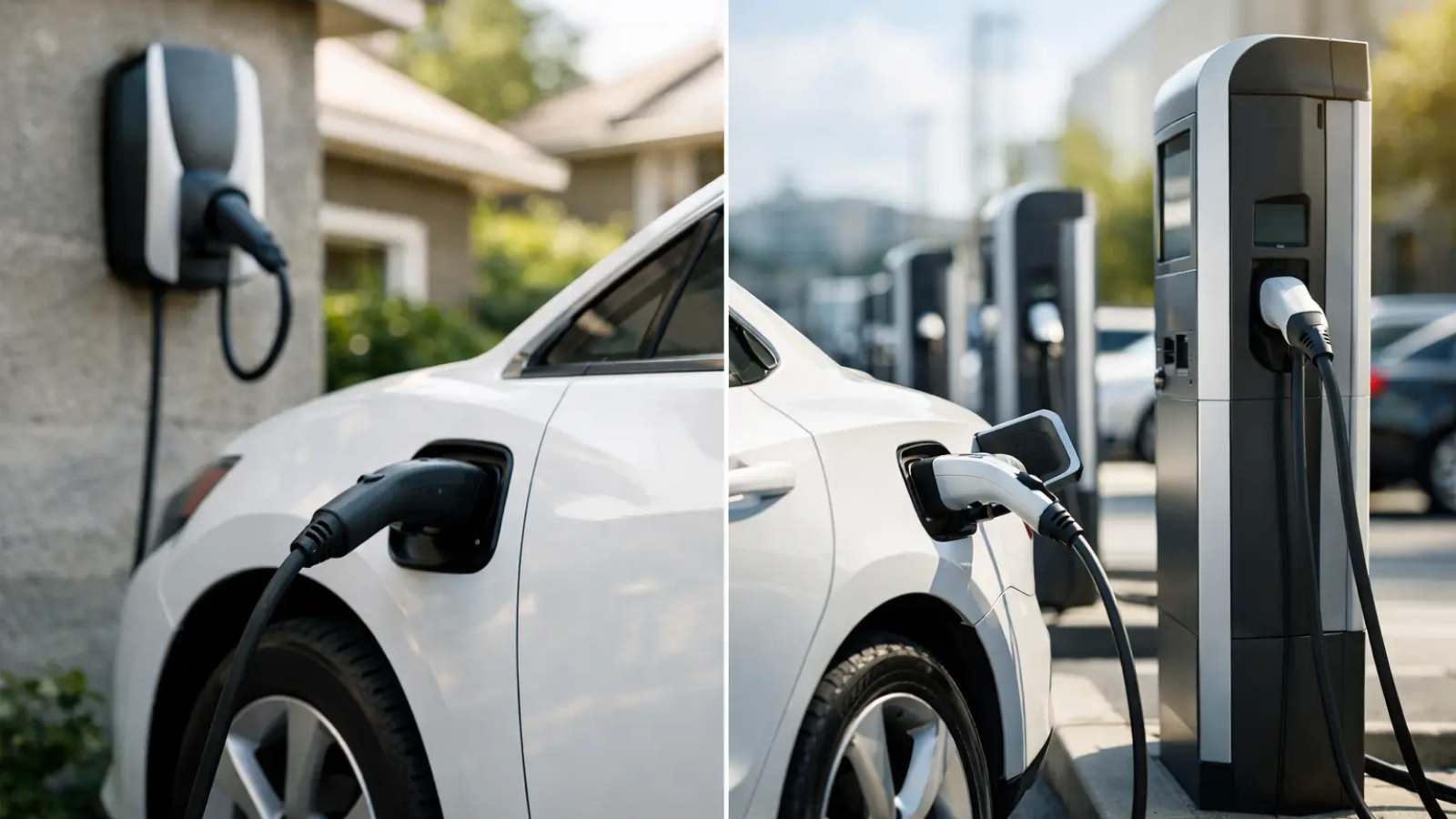
You feel the difference between charging at home and charging in public the first week you own an EV. One option becomes part of your routine while you sleep. The other asks for planning, waiting, and sometimes a little luck. That is why home charger versus public charging is not really a question of which one is better in every case. It is a question of which one fits how you drive, where you live, and what kind of energy future you want to build around your vehicle.
For most drivers, the real answer is not one or the other. It is a mix. But the balance matters, because it affects your monthly costs, your time, and the reliability of your daily transportation.
Home charger versus public charging for everyday use
If your EV is your primary car, home charging usually changes the ownership experience more than the vehicle itself. Instead of making fuel stops, you plug in at the end of the day and start the next morning with the range you need. That convenience is hard to overstate. Charging at home turns energy into something you manage quietly in the background.
Public charging works differently. It is essential infrastructure, especially for drivers who take longer trips, live in apartments, or do not yet have access to a dedicated parking space. But it is still shared infrastructure. You may need to drive to the charger, wait for availability, and move your car when charging is complete. Even when stations are easy to find, public charging adds friction that home charging often removes.
That does not mean public charging is the weaker option. For some drivers, it is the only practical one, and fast chargers can make road trips and high-mileage driving possible. The better way to look at it is this: home charging is usually best for consistency, while public charging is best for flexibility.
Cost is where the difference becomes clear
The biggest long-term advantage of a home charger is usually cost control. Residential electricity rates are often lower than public charging rates, especially compared with DC fast charging. If you charge overnight during off-peak hours, the savings can become even more meaningful over time.
A home charger also gives you more predictability. Your utility bill may rise, but the cost per mile is generally easier to estimate from month to month. For households already thinking about solar, the economics become even more interesting. Charging your EV with solar-generated electricity can lower operating costs further and connect transportation with a broader clean energy strategy.
Public charging has a different cost structure. Level 2 public stations can be reasonable in some locations, but pricing varies. DC fast charging is usually the most expensive option, and frequent use can narrow the savings gap between EVs and gas vehicles. You are also paying for convenience, high-power equipment, commercial electricity rates, and network operations.
For drivers who only use public charging occasionally, that premium may be completely acceptable. For drivers who rely on it every week, it is worth calculating the real annual cost rather than assuming all EV charging is equally cheap.
Speed depends on the charger and the situation
Charging speed is one of the most misunderstood parts of EV ownership because faster is not always more useful.
A standard wall outlet at home is slow, often adding only a few miles of range per hour. A dedicated Level 2 home charger is a different story. It can typically recharge most daily driving overnight, which is exactly what most households need. You are not necessarily chasing the fastest possible charge. You are making sure your vehicle is ready every morning.
Public charging includes both Level 2 and DC fast charging. Public Level 2 chargers are helpful for top-ups while you work, shop, or eat. DC fast chargers are built for speed, especially when you need to recover substantial range during a trip. In the right conditions, they can add meaningful range in a relatively short stop.
Still, charging speed in public is not just about the charger rating. It depends on your vehicle, battery temperature, state of charge, and station performance. A charger may advertise high output, but your actual charging session can vary. Home charging is slower on paper than fast charging, yet often more efficient in practice because it happens during hours when the car is already parked.
Convenience is about more than plugging in
When people compare home charger versus public charging, they often focus on hardware. The larger issue is lifestyle.
Home charging is convenient because it saves trips. You park, plug in, and go inside. There is no detour before work, no waiting behind another driver, and no need to monitor station status unless something is wrong. For busy households, that simplicity can be the deciding factor.
Public charging can still be very convenient when it matches your routine. Charging at the office, at a retail center, or during a regular stop can work well. For urban drivers without private parking, a reliable nearby charging hub may be entirely workable. But public charging becomes less convenient when access is inconsistent or when charging requires a separate trip.
This is where location matters more than preference. A homeowner with a driveway will usually experience EV charging very differently from a condo resident who depends on shared parking. The right answer has less to do with ideology and more to do with infrastructure.
Reliability and control matter more than many buyers expect
A home charger gives you control. You know where your charger is, when it is available, and how you use it. That reliability reduces range anxiety because your charging plan is not competing with anyone else.
Public charging networks continue to improve, and they are a critical part of EV adoption. Still, public infrastructure comes with variables. A charger may be occupied, offline, slower than expected, or located in a place that is not ideal late at night or during peak hours. None of these issues make public charging unworkable, but they do affect confidence.
For fleet operators, property managers, and businesses, that same principle applies at a larger scale. Dedicated charging infrastructure creates operational certainty. Shared public infrastructure creates reach, but not always control.
Sustainability is not just about driving electric
Both home and public charging support lower-emission transportation, but the source of electricity still matters.
Home charging creates the clearest path to a more integrated clean energy setup. If your home uses renewable power or you plan to add solar, your EV becomes part of a larger system that reduces grid dependence and improves energy resilience. That is one reason many homeowners see charging infrastructure as more than a vehicle upgrade. It is a step toward a cleaner property energy model.
Public charging can also support sustainability goals, especially as networks incorporate cleaner electricity sources and more efficient energy management. In many regions, public charging helps expand EV access for people who cannot install chargers at home, which is essential for broader adoption. Accessibility is part of sustainability too.
So the greener option is not always defined by location alone. It depends on energy sourcing, usage patterns, and whether charging infrastructure helps more people move away from fossil fuels.
Who should prioritize a home charger?
A home charger makes the strongest case for homeowners, frequent drivers, multi-EV households, and anyone who values routine and predictable costs. It is especially compelling if you have dedicated parking and want to pair charging with off-peak electricity or solar.
It also makes sense for people who do not want charging to become a weekly task. If your goal is to make EV ownership feel easier than driving a gas vehicle, home charging is often the missing piece.
Who may rely more on public charging?
Public charging remains a practical choice for apartment residents, urban drivers, occasional EV users, and people who are not ready to install equipment at home. It also plays a central role for long-distance travel and for businesses that need charging access across multiple locations.
If public chargers are plentiful near your home or workplace, relying on them may be reasonable. The key is consistency. Occasional access is not the same as dependable access.
Charge & Go often speaks to customers who are thinking beyond a charger purchase and looking at how mobility, property energy use, and sustainability connect. That is the right lens here. The best charging setup is the one that supports your daily life now while keeping room for a cleaner, more resilient energy system over time.
The smartest EV drivers usually do not choose between home and public charging as if only one can matter. They build around home charging if they can, then use public infrastructure where it adds range, flexibility, and confidence. If you are deciding where to start, ask a simpler question: when do you want charging to happen – while you are living your life, or while you are waiting for your car?
Add a Comment