
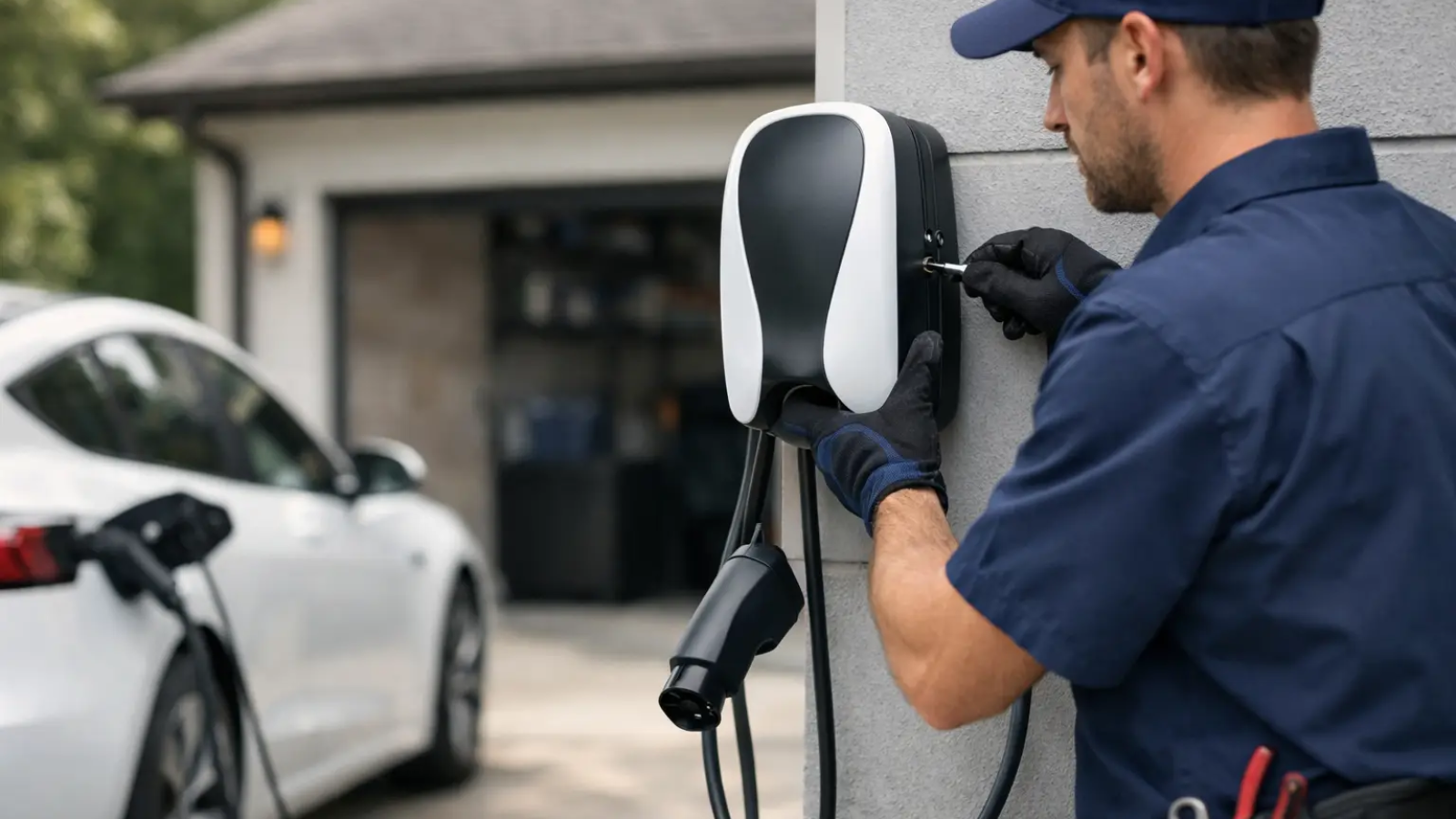
A home EV charger should make life easier, not add risk behind your walls. If you want to install home EV charger safely, the real work starts before the charger is mounted – with your panel capacity, circuit design, location, permits, and the electrician you trust to do the job right.
For most homeowners, this is not a DIY upgrade. EV charging puts a sustained electrical load on your home for hours at a time, which means mistakes that seem minor during installation can become expensive or dangerous later. A safe setup is less about buying the most powerful charger and more about building a system your home can support every day.
What safe EV charger installation actually means
Safe installation is not just about avoiding shocks or tripped breakers. It means the charger is matched to your vehicle, your electrical service, and your daily driving habits. It also means the wiring is sized correctly, the breaker is appropriate for the load, the equipment is rated for the environment, and the final installation meets local electrical code.
That last point matters more than many buyers expect. A charger may be perfectly good hardware, but if it is installed on an overloaded panel, exposed to weather it was not designed for, or placed where the cable creates a trip hazard, the whole system becomes less reliable. Safety and convenience tend to go together here. A well-planned installation usually feels easier to use because it was designed with real life in mind.
Before you install home EV charger safely, check your electrical capacity
The first technical question is simple: does your home have enough available electrical capacity for EV charging? Many homes can support a Level 2 charger, but not all homes can support the same charging speed without upgrades.
A Level 2 charger typically uses a 240-volt circuit and can draw anywhere from around 16 to 80 amps, depending on the charger and vehicle. In practice, many residential installations land in the 32- to 48-amp charging range. That is often more than enough for overnight charging, but it still adds meaningful load to the home.
An electrician should perform a load calculation to see what your panel can handle. If your panel is already close to capacity because of air conditioning, water heating, electric cooking, or other major appliances, you may need a panel upgrade or a load management solution. This is where trade-offs come in. A lower-amperage charger may be slower, but it can avoid a much more expensive electrical upgrade while still covering your daily commute.
For many households, faster is not automatically better. If you drive 30 to 50 miles a day and charge overnight, a moderate Level 2 setup may be the smartest choice. It supports your routine without overbuilding the system.
Choosing the right location matters more than most people think
Placement affects safety, cost, and how likely you are to use the charger properly. The ideal location is close enough to your parking spot that the cable reaches comfortably without stretching across walkways or drive areas. It should also be accessible enough that plugging in feels easy at the end of a long day.
Garage installations are often the simplest because the charger is protected from weather and usually closer to the electrical panel. Outdoor installations can work just as well, but the charger must be rated for exterior use and mounted in a location that reduces exposure to standing water, direct impact, and unnecessary cable wear.
Think about your next vehicle too. If you might switch from a sedan to a larger SUV, or if your household may add a second EV, charger placement should leave some room for flexibility. A slightly smarter location now can save you from rerouting wiring later.
Hardwired vs plug-in chargers
One of the most common questions is whether to install a hardwired charger or a plug-in model. Both can be safe when installed correctly, but they suit different homes and priorities.
Hardwired chargers are connected directly to the electrical circuit. They are often preferred for higher-amperage installations and can provide a cleaner, more permanent setup. Because there is no receptacle involved, there is one less connection point in the system. For outdoor use or long-term ownership, hardwired units are often the stronger choice.
Plug-in chargers connect to a dedicated 240-volt outlet. They can be easier to replace or take with you if you move, which appeals to some homeowners. But the outlet must be the correct type, installed to code, and rated for the continuous load. This is not the place to cut corners with low-quality receptacles or adapters.
If your goal is maximum reliability and a long-term home charging setup, hardwired often makes the most sense. If flexibility matters more and the electrical conditions support it, plug-in can still be a good option.
Permits, code compliance, and inspection are part of safe installation
Some homeowners see permits as a delay. In reality, permits and inspections are part of how you install home EV charger safely and protect your investment.
Electrical codes exist because EV charging is a continuous load. The circuit, breaker, wiring method, disconnect requirements, and equipment rating all need to meet local standards. A permitted installation also gives you documentation that can matter for insurance, resale, or future electrical work.
Local requirements vary. Some jurisdictions are straightforward, while others have more detailed rules around load calculations, outdoor mounting, or panel labeling. A qualified electrician should know what applies in your area and handle the process correctly. If someone offers to skip permits to save time or money, that is a warning sign.
Why a licensed electrician is non-negotiable
An EV charger is not like swapping a light fixture or adding a standard outlet. It involves sustained current, dedicated circuits, and code-specific installation practices. A licensed electrician understands conductor sizing, breaker coordination, grounding and bonding, panel limitations, and how to identify signs that your existing system is not ready.
Just as important, a good installer will ask practical questions. How far is the panel from the parking location? Is the charger going indoors or outdoors? How many miles do you drive per day? Are you planning for one EV or two? Do you have solar now, or are you considering it later?
Those questions shape the right design. At Charge & Go, that broader view matters because home charging works best when it is considered as part of your overall energy setup, not as a standalone device on the wall.
Common mistakes that make charging less safe
Most problems do not come from the charger itself. They come from poor planning or bad installation choices.
One common mistake is oversizing the charger for the home. People assume the highest amperage is the best value, then discover their panel cannot support it without strain or expensive upgrades. Another is poor cable management. A charger may be electrically sound but still unsafe if the cable runs across a walkway where someone can trip or drive over it.
Outdoor mistakes are also common. Installing a unit in a location with excessive weather exposure, using equipment not rated for the environment, or failing to protect the circuit properly can shorten the life of the charger and increase risk. Then there is the temptation to use extension cords or adapters. For EV charging, that is a hard no.
There is also a less obvious issue: future demand. If your home may add solar, battery storage, or another EV, the charger installation should not box you into a corner. Safe planning includes some long-term thinking.
Smart charging features can support safety and efficiency
Modern EV chargers often include app controls, scheduling, load management, and energy monitoring. These features are convenient, but they can also help create a safer and more efficient setup.
Load management is especially useful in homes with limited panel capacity. It allows charging to adjust based on other electrical demand in the house, reducing the chance of overload. Scheduling can also help by shifting charging to off-peak hours, which may lower electricity costs and align better with solar production or utility rate plans.
These features are not a substitute for proper installation, but they do improve how well the system fits your home. The best charger is not just the one with the longest feature list. It is the one that works reliably within your actual electrical conditions.
A safe installation supports the bigger clean energy picture
Home charging is one of the most practical steps a household can take toward lower-emission transportation. But the sustainability benefit is strongest when the installation is built to last. A charger that is correctly sized, properly installed, and integrated into your home energy plan will serve you better than a rushed setup that creates maintenance issues or limits future upgrades.
That is especially true if solar is part of your roadmap. EV charging and solar can complement each other well, but only when the electrical design accounts for both. Thinking ahead now can give you more options later.
The best time to ask hard questions is before the installation starts. How much charging speed do you really need? Can your panel support it? Is the charger going in the right location for daily use and future flexibility? Get those decisions right, and your charger becomes what it should be from day one – a dependable part of a cleaner, smarter home.
Add a Comment