
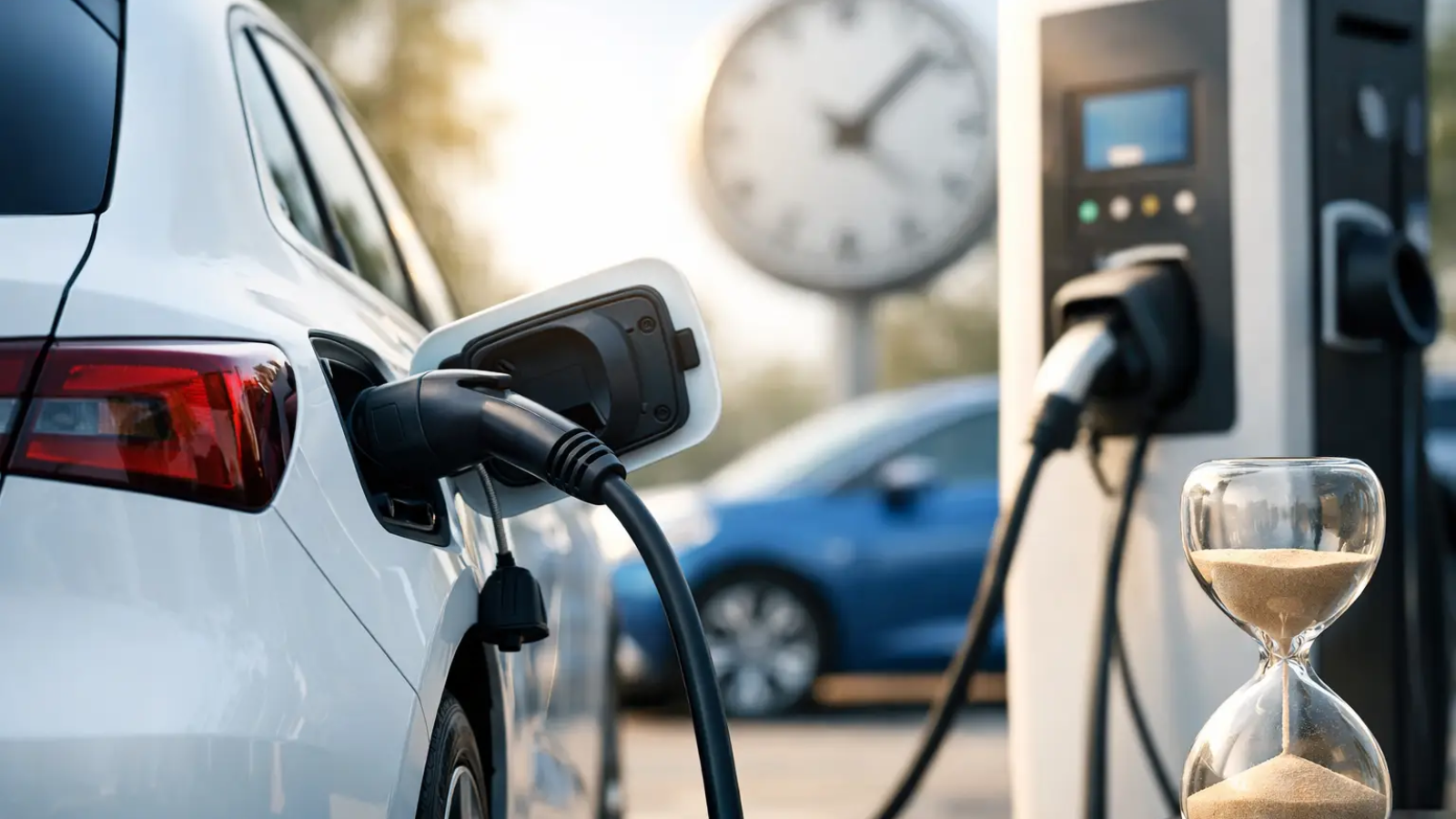
You pull into a charger with 18% battery, glance at the screen, and see a charge estimate that feels longer than expected. That moment captures the real question behind electric vehicle charging time: not just how long charging takes, but why the answer changes so much from one vehicle, charger, and setting to the next.
For drivers, property owners, and businesses planning charging infrastructure, this matters because time shapes convenience. It affects commuting routines, fleet uptime, guest satisfaction, and how confidently people make the switch to electric mobility. The good news is that charging time is predictable once you understand the few factors that control it.
What affects electric vehicle charging time?
Electric vehicle charging time is mainly determined by three variables: the charger’s power output, the vehicle’s maximum charging acceptance rate, and the battery size. If any one of those creates a bottleneck, charging slows down.
Start with the charger itself. A standard Level 1 charger using a household outlet is the slowest option and is best suited to overnight top-ups for low-mileage drivers. Level 2 charging is significantly faster and is often the right fit for homes, workplaces, multifamily properties, and destination charging. DC fast charging is the quickest public option, designed for rapid energy delivery during travel, commercial use, or short dwell times.
But the charger does not make the decision alone. Every EV has a limit on how much power it can accept. Even if a charger can deliver 150 kW, a vehicle that only accepts 75 kW will charge at that lower rate. This is one of the most common reasons people expect faster sessions than they actually get.
Battery size also matters. A larger battery generally takes longer to fill than a smaller one, just as a larger fuel tank takes longer to refill at the same flow rate. At the same time, larger batteries can offer more range, so the charging trade-off is not always a downside.
Charging levels and typical time ranges
Level 1 charging
Level 1 charging usually adds around 3 to 5 miles of range per hour, depending on the vehicle. For a plug-in hybrid or a driver with short daily mileage, that may be enough. For a fully electric vehicle with a large battery, it is often too slow to serve as a primary charging solution.
A full charge on Level 1 can take well over 24 hours for some EVs. That sounds extreme, but in practice many drivers do not charge from 0% to 100%. They are simply replacing the energy used during the day.
Level 2 charging
Level 2 is the practical standard for most everyday charging. It commonly adds about 20 to 40 miles of range per hour, though the real number depends on the charger power and the car’s onboard charger.
For many EVs, a full charge on Level 2 takes roughly 4 to 10 hours. That range is exactly why Level 2 works so well at homes and workplaces. It aligns with long parking periods, which means charging can happen in the background without disrupting the day.
DC fast charging
DC fast charging can add substantial range in a short stop, often bringing a battery from 10% to 80% in around 20 to 45 minutes. Some vehicles charge faster, some slower. The charger rating, battery condition, and temperature all influence the result.
The key detail is that fast charging is fastest in the middle of the battery range, not at the top. That is why many charging sessions are measured from 10% to 80% rather than 0% to 100%.
Why charging slows down near 80%
Many new EV drivers notice that charging starts strong and then tapers off. This is normal battery management, not a charger problem.
As the battery fills, the vehicle reduces charging speed to protect battery health and control heat. Think of it as a careful finish rather than a full-speed sprint. The final 20% can take disproportionately longer than the first 60% or 70%, especially on a DC fast charger.
This matters for trip planning and for public charging site design. If a driver is waiting for 100% at a fast charger, they may spend much more time than necessary. In many cases, it is more efficient to charge only to 80% and continue the trip, then recharge again if needed.
Real-world factors that change charging speed
Temperature
Battery temperature has a major impact on charging performance. In cold weather, charging can slow down because the battery needs to warm up before it can safely accept higher power. In very hot conditions, the system may also limit speed to manage heat.
This is one reason real charging sessions do not always match ideal lab-style numbers. Climate, season, and even whether the vehicle was recently driven all play a part.
Battery state of charge
A battery at 15% will usually charge faster than one already sitting at 70%. Charging speed is not linear, especially with DC fast charging. Drivers looking for the quickest stop often arrive with a lower battery level and leave before the taper becomes steep.
Shared charging power
At some public sites, power may be shared between chargers. If multiple vehicles are plugged in, each session may receive less power than the maximum advertised rate. This does not happen everywhere, but it is common enough to be worth understanding.
Vehicle software and battery chemistry
Some EVs are simply better optimized for fast charging than others. Software, thermal management, and battery chemistry all influence how consistently a vehicle can charge at high speed. Two cars with similar battery sizes may produce very different charging times in real use.
How to estimate charging time more accurately
The simplest way to estimate charging time is to look at how much energy the battery needs and compare it with the charger’s usable output. A 60 kWh battery that needs about half a charge requires roughly 30 kWh of energy. On a 7.2 kW Level 2 charger, that may take a little over four hours in ideal conditions, though some energy loss and charging taper can extend the total.
That last point matters. Charging is not 100% efficient. Some energy is lost as heat, and charging speed varies across the session. So estimates should be treated as practical ranges, not exact promises.
For homeowners and businesses, the better question is often not “How fast can this charge?” but “Will this charge reliably fit the parking time available?” That shifts the focus from peak speed to everyday usability.
What this means for homeowners
For most households, overnight Level 2 charging is the sweet spot. It is fast enough to replenish daily driving, convenient enough to feel invisible, and well suited to pairing with broader energy goals like smart scheduling or solar integration.
Level 1 may work for some drivers, but it leaves less flexibility. If daily mileage rises, or if multiple EVs share a home, charging can quickly become inconvenient.
That is why many homeowners installing EV charging are not just buying speed. They are buying consistency. A properly selected Level 2 setup gives them dependable access to a full or nearly full battery each morning without relying on public infrastructure.
What this means for commercial properties
For businesses and property managers, electric vehicle charging time affects more than convenience. It influences turnover, utilization, and the kind of charging experience a site can support.
At offices, hotels, apartments, and retail destinations, Level 2 charging is often the strongest fit because vehicles remain parked for hours. In those settings, ultra-fast charging may be unnecessary and more expensive than the use case demands.
For fleets, highway-adjacent sites, and locations where dwell time is short, DC fast charging can make more sense. But higher speed comes with trade-offs, including installation complexity, energy demand, and cost. The right charging strategy depends on how long vehicles stay parked and what outcome the site is meant to deliver.
The smarter way to think about charging time
Electric vehicle charging time is not one fixed number, and that is exactly why planning matters. The right charger is the one that matches real behavior: how far people drive, how long they park, what vehicles they use, and how the property manages power.
At Charge & Go, that practical view sits at the center of clean energy planning. Charging works best when it is designed around daily patterns, not just maximum specs on a brochure.
As EV adoption grows, the conversation is moving beyond speed alone. The more useful question is whether charging fits naturally into life, work, and energy use. When it does, the transition to electric mobility feels less like a compromise and more like progress you can count on every day.
Add a Comment