
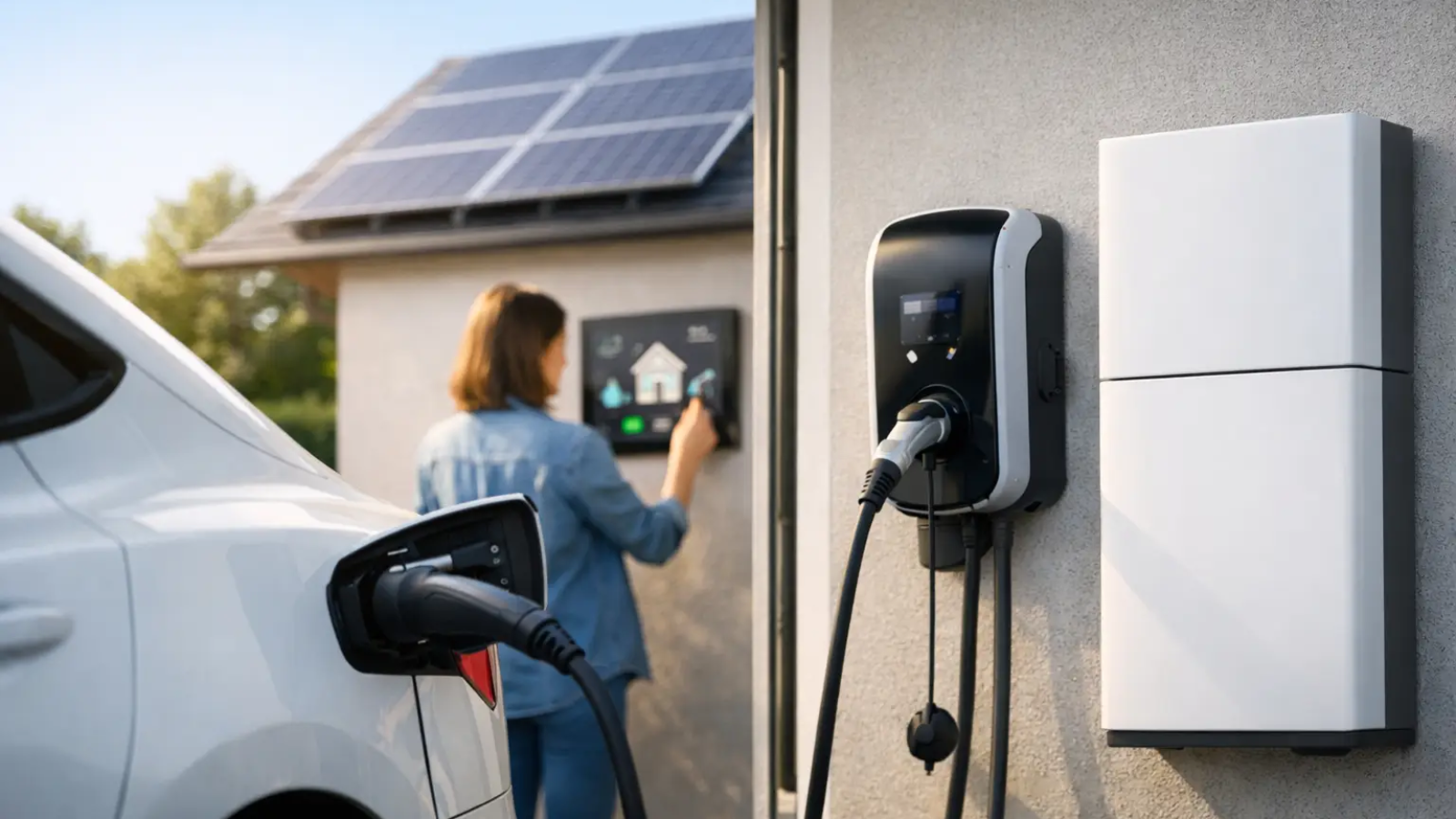
An EV can be one of the largest electrical loads in a home. Plugging in at the wrong time can raise charging costs, increase pressure on the grid, and draw power when your solar system is producing little or none. Smart charging with home energy management gives homeowners a better option: let the home, charger, battery, solar panels, and utility rate schedule work together.
This is not about making charging complicated. It is about setting a few useful priorities so your vehicle is ready when you need it, while your energy is used more intentionally. For households building a cleaner energy future, that coordination can make a meaningful difference.
What smart charging actually does
A basic home charger delivers electricity as soon as a vehicle is connected, unless the driver sets a timer in the vehicle or charging app. Smart charging adds decision-making. It can schedule, pause, slow, or resume charging according to conditions you choose.
Those conditions may include the time of day, your utility’s electricity prices, your home’s current power demand, available solar generation, and the vehicle’s required departure time. Instead of treating charging as a fixed overnight task, the system treats it as a flexible energy load.
For example, a driver who leaves at 7 a.m. may only need 25 kWh to cover the next day’s travel. A smart charger can deliver that energy during the least expensive overnight window rather than charging at full power from the moment the car arrives home. If the household has rooftop solar and the car is parked during the afternoon, it may prioritize excess solar generation instead.
The goal is not always to charge at the lowest possible rate or use only solar power. Reliable mobility comes first. The value comes from choosing the best charging window that still meets the driver’s needs.
Why home energy management changes the equation
Smart charging is powerful on its own, but home energy management provides the wider view. It monitors or coordinates major energy flows across the property, including solar production, household consumption, battery storage, and EV charging.
Without that broader view, a charger may know that electricity is cheaper after midnight but not recognize that the home is already running a heat pump, water heater, or other high-demand equipment. In some homes, running several large loads at once can push usage into an expensive rate tier, exceed a service limit, or require costly electrical upgrades.
A home energy management system can respond by reducing charging output temporarily. This is often called load management or load balancing. The EV continues charging, just at a rate that better fits the home’s available capacity. Once other demand falls, the charger can increase output again.
That flexibility matters especially in properties with limited electrical capacity. A homeowner may be able to install EV charging without immediately upgrading the electrical panel, depending on local codes, equipment specifications, and the home’s load calculation. A qualified installer should assess this carefully. Smart controls can support a practical design, but they do not replace safe electrical planning.
Smart charging with home energy management and solar
Solar makes the conversation more interesting. Midday solar production can be abundant, while household demand may be modest if residents are away. Exporting that excess energy to the grid may earn a lower credit than the price paid to buy electricity later. Charging an EV with available solar can improve the value of each kilowatt-hour generated at home.
A solar-aware charging setup can adjust EV charging to follow surplus production. If clouds reduce output, the charger can lower its rate. If generation rises again, it can increase charging within the limit you set. This approach helps maximize self-consumption without forcing the household to constantly watch an app.
Still, solar-first charging is not the right answer for every driver. Someone who commutes during the day may not have a vehicle at home when solar production peaks. In that case, time-of-use charging overnight may deliver greater savings. A household with a battery may also choose to store midday solar for evening use rather than send it to the EV immediately.
The best strategy depends on driving patterns, local electricity rates, solar output, export compensation, and whether the home has energy storage. Good energy management is not about following a single rule. It is about setting priorities that reflect real life.
Start with your household’s charging pattern
Before choosing features, understand how much flexibility you actually have. Look at the distance you drive in a typical week, when the vehicle is usually parked at home, and when it must be ready to leave. Most drivers do not need to refill the battery from near-empty every night.
That gap between when the car arrives and when it needs to depart is the opportunity. A vehicle parked from 6 p.m. to 7 a.m. has a long charging window. Even if the charger operates at a lower rate for part of the night, it may still add more than enough range by morning.
It also helps to review your utility bill. If your provider offers time-of-use rates, identify the off-peak, mid-peak, and peak periods. The lowest rate window is often a sensible default, but check for seasonal changes and special EV plans. Rate structures vary widely, and the cheapest charging schedule is not always obvious from a single month’s bill.
Features worth prioritizing
The most useful setup is one that matches the home, not the one with the longest feature list. When comparing chargers and energy management options, focus on whether the system can schedule charging around utility rates, set a required state of charge or departure time, and adjust output based on household load.
Solar households should also consider whether the charger can respond to excess generation. If battery storage is part of the plan, confirm how the system handles competing priorities. Some homeowners want to preserve battery capacity for backup power. Others prioritize reducing grid purchases in the evening. The controls should make those preferences clear and easy to change.
Interoperability deserves attention as well. A charger, inverter, home battery, and energy monitor may come from different manufacturers. They do not always share data or offer the same level of control. Ask what information is visible in one app, what automation is supported, and what happens if the internet connection is temporarily unavailable.
Data privacy is another practical consideration. Connected energy devices collect information about charging times and electricity use. Choose providers that clearly explain how data is handled, give users control over account access, and maintain software updates over time.
Avoid chasing savings at the expense of convenience
Automation should reduce decisions, not create daily friction. Set a minimum charge level that keeps the car useful for unexpected trips, then allow the system to optimize the rest. A driver who routinely needs 60 miles of range the next day should not wake up with an undercharged vehicle because the system waited too long for a perfect solar or price signal.
It is also wise to revisit settings as life changes. A new job, a different utility rate plan, a second EV, or the addition of solar panels can all change the best charging approach. Seasonal shifts matter too. Solar output and household heating or cooling loads may look very different in July than they do in January.
For property managers and business operators, the same principle applies at a larger scale. Managed charging can prevent multiple vehicles from drawing maximum power at once, helping make better use of existing electrical infrastructure. Clear charging policies and reliable access remain essential, but intelligent scheduling can reduce operating costs while supporting more drivers.
A cleaner home energy routine
The practical promise of smart charging is simple: use electricity when it makes the most sense for your home, your budget, and the grid. It can lower costs, make solar more useful, and reduce unnecessary strain during high-demand periods. More importantly, it turns EV ownership into an active part of a home’s clean energy strategy rather than an isolated appliance in the garage.
Start with the schedule you already live by, then choose controls that protect your daily driving needs first. From there, every smarter charging decision can help move your household toward cleaner, more efficient miles.
Add a Comment