
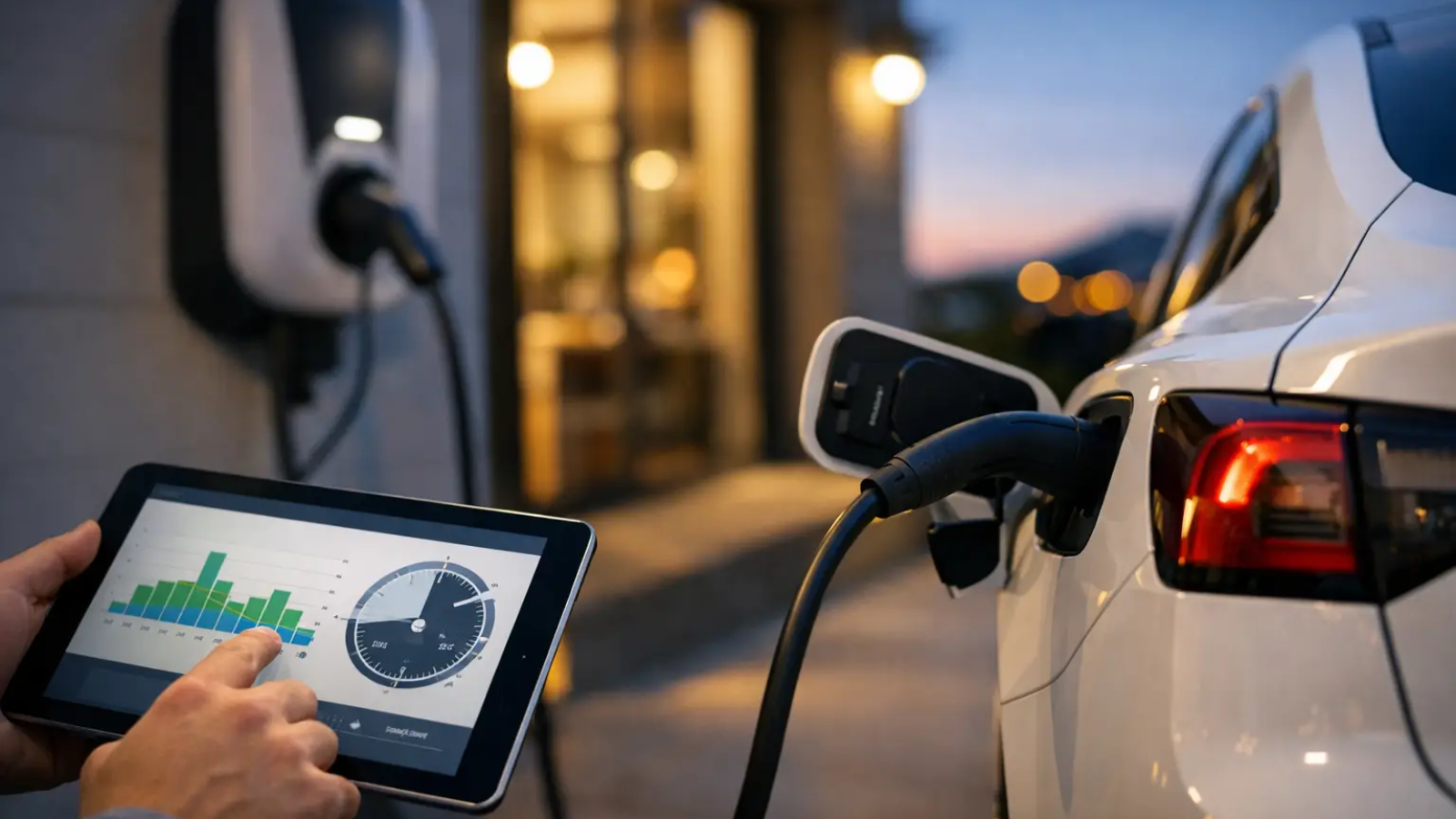
A parked EV can become one of the smartest energy assets at your home or property – but only if it charges at the right time. When you set up EV charging schedule settings around your actual driving needs, electricity rates, and available solar power, charging becomes less expensive, more predictable, and easier on the local grid.
For most drivers, the goal is not to charge as fast as possible every time. It is to wake up with enough range for the day while using cleaner, lower-cost electricity whenever possible. The right schedule makes that routine automatic.
Why an EV charging schedule matters
Plugging in after every drive is convenient, but it can also mean charging during the most expensive hours of the day. In areas with time-of-use electricity plans, rates often rise in the late afternoon and early evening, when homes, businesses, and air conditioning systems are all drawing power. Overnight electricity may cost substantially less.
A charging schedule tells your vehicle, charger, or energy management system when charging should begin and end. This gives you control over three practical priorities: energy cost, battery readiness, and sustainability.
For homeowners with solar, scheduling adds another decision. Charging in the middle of the day can make good use of surplus solar generation. Charging overnight may be cheaper if your utility has favorable off-peak rates. Neither approach is universally better. The best choice depends on your solar output, electricity plan, driving patterns, and whether your utility offers credits for power exported to the grid.
For workplaces, apartments, and commercial properties, scheduled charging can also reduce demand spikes. If several vehicles begin charging at once, the property may face higher peak demand and greater strain on existing electrical infrastructure. Smart scheduling helps spread that load across available hours.
Before you set up an EV charging schedule
Start with the tools you already have. Many EVs offer scheduled charging through the vehicle’s dashboard or mobile app. Most connected Level 2 chargers also include scheduling controls. Some homes have a utility app, smart meter, solar monitoring platform, or home energy management system that can coordinate charging with rates and solar production.
Use one primary scheduling system whenever possible. Setting overlapping schedules in both the vehicle and charger app can create confusion. For example, a charger may be ready to operate at midnight while the vehicle is set not to accept power until 1:00 a.m. The result may be an unexpectedly uncharged car in the morning.
Check these details before creating your schedule:
- Your usable battery capacity and current state of charge
- Your typical daily mileage and the range you need for unexpected trips
- Your charger’s power level, usually measured in kilowatts
- Your utility’s peak, off-peak, and super off-peak periods
- Your solar generation pattern, if you have a solar system
- Your planned departure time on workdays and weekends
You do not need to calculate every charging session perfectly. A clear baseline is enough. If you drive 35 miles most days and your EV provides roughly 3 to 4 miles per kilowatt-hour, replacing that energy generally requires around 9 to 12 kilowatt-hours. A Level 2 charger can often deliver that amount in just a few hours.
Set up EV charging schedule settings step by step
1. Choose a realistic departure target
Start with the time you need the vehicle ready, not the time you plug it in. If you leave at 7:30 a.m., set that as your departure time in the vehicle or charging app. Many EVs can then calculate when to begin charging so the battery reaches your selected level before you leave.
This approach is more efficient than programming a fixed start time for every night. Your car will not always arrive home with the same battery level. Departure-based charging adapts to the energy actually needed.
If your vehicle or charger only supports a start and stop time, build in a reasonable buffer. For example, if your car typically needs three hours to recharge and off-peak pricing begins at 11:00 p.m., schedule charging from 11:00 p.m. to 4:00 a.m. rather than ending at exactly 2:00 a.m.
2. Set a daily charging limit that fits your driving
For everyday use, many EV manufacturers recommend a charge limit below 100 percent. A setting around 70 to 90 percent is common for daily driving, but your owner’s manual should guide the final number. Reserving 100 percent for longer trips can support long-term battery care while still providing ample range for most commutes.
There are exceptions. Some battery chemistries and manufacturers provide different guidance, and some drivers need a higher daily limit because they travel farther or lack reliable charging at their destination. The useful rule is simple: set the lowest charge target that reliably covers your normal day with a comfortable margin.
3. Match the schedule to your electricity rate plan
Review your utility bill or online account for time-of-use periods. Look beyond the words “off-peak” and confirm the exact hours, including weekend and seasonal changes. A schedule that saves money in winter may not be optimal during summer peak periods.
If your lowest rate is overnight, set charging to begin at the start of that window. If the off-peak period is short, use a departure-based setting or calculate whether your charger can add enough energy before morning. A standard 7.2-kilowatt Level 2 charger adds far more range per hour than a regular wall outlet, making overnight scheduling practical for most households.
Avoid assuming that charging after midnight is always cheapest. Some utilities have daytime renewable-energy pricing, and some regions have very low rates in the middle of the day. Your actual tariff should lead the decision.
4. Decide how solar fits into the plan
Solar-powered EV charging is appealing because it connects transportation with clean electricity generated on-site. However, solar production changes with weather, season, roof orientation, and household energy use.
If your system regularly produces surplus power during the day and someone is home to plug in, daytime charging may be a strong option. It can increase direct use of your solar generation rather than exporting excess electricity to the grid. This is especially valuable when export credits are lower than the cost of buying electricity later.
If the EV is away during solar hours, overnight off-peak charging may remain the more practical choice. A hybrid approach also works well: schedule primary charging overnight, then use daytime solar charging on weekends or work-from-home days. Charge & Go encourages customers to view EV charging and solar as one energy strategy, not two separate upgrades.
5. Test the schedule for one week
A schedule is only useful if it works under real conditions. For the first week, check whether the vehicle reaches its target charge before departure and whether the charging session stays within your intended rate period.
Pay attention to changes in routine. A late arrival, an unexpected trip, or a day with heavy driving can alter the result. Most smart chargers allow a one-time “charge now” override, which is useful when you need immediate range without permanently changing your routine.
Common scheduling mistakes to avoid
The most common mistake is treating a schedule as a set-and-forget feature. Electricity rates, commuting patterns, and solar production can all change. Review the settings when your utility updates its tariff, when daylight saving time shifts, or when your driving needs change.
Another mistake is scheduling every charge to 100 percent simply because the vehicle is connected. That may be appropriate before a road trip, but it is often unnecessary for daily use. Setting a practical target leaves room for regenerative braking and avoids carrying extra battery weight you do not need.
Finally, do not overlook charging location settings. Some EVs let you create separate schedules for home, work, and other frequent destinations. This prevents the vehicle from delaying a public charging session when you need to charge immediately away from home.
Scheduling for apartments, workplaces, and fleets
Property managers and business operators have additional variables to consider. Shared chargers need clear rules so every driver has fair access, while the site needs to stay within its electrical capacity. Smart load management can reduce charging power temporarily when building demand is high, then increase it when capacity becomes available.
For a workplace, daytime charging may align well with solar generation and employee parking hours. For an apartment community, overnight scheduling is often more relevant, particularly when many residents return home at similar times. Fleets may prioritize vehicle readiness by dispatch time, assigning charging windows based on route length and operational priority.
The strongest system is not necessarily the one that charges every vehicle at maximum power. It is the one that meets transportation needs reliably while using energy and infrastructure efficiently.
A well-planned schedule turns charging from another household task into a quiet background routine. Start with your departure time, adjust for your rate plan and solar production, and let each parked hour do more for your budget and cleaner transportation goals.
Add a Comment