
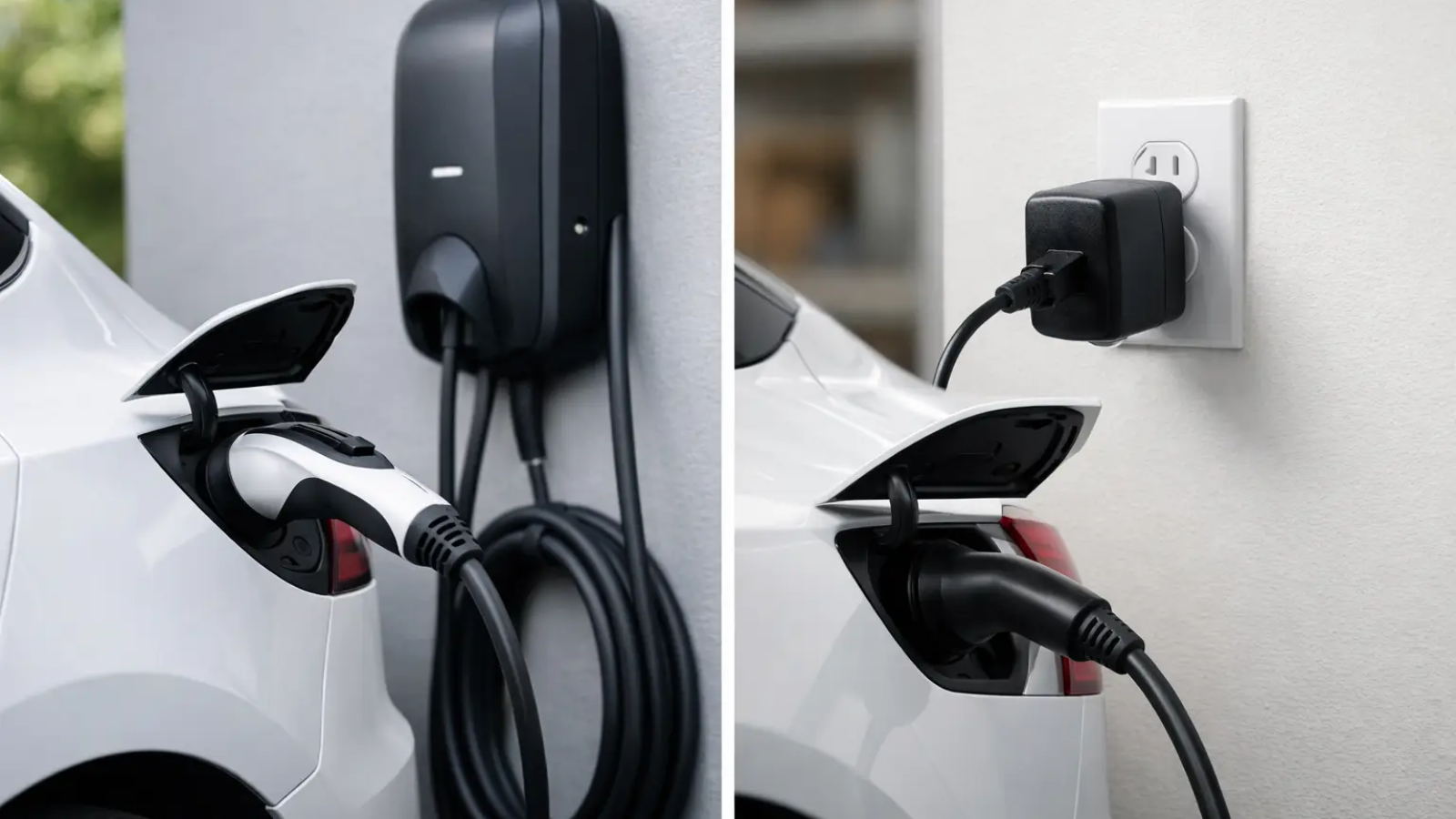
A new EV can make a standard wall outlet feel like a perfectly reasonable starting point. Plug in at night, wake up with more range, and avoid an upfront installation. But the EV charger versus standard outlet decision becomes more consequential once charging has to fit real life: commutes change, household energy use grows, and the vehicle becomes your everyday transportation.
A standard outlet can be enough for some drivers. A dedicated Level 2 EV charger is often the better long-term choice for households that need faster, more predictable charging. The right answer depends less on the vehicle alone than on how far you drive, where you park, and whether your electrical system can support the upgrade.
EV Charger Versus Standard Outlet at a Glance
In the United States, a standard household outlet typically provides 120 volts of electricity. Charging an EV from it is known as Level 1 charging. Most EVs include a portable charging cable that works with this type of outlet, so there is little to buy beyond the vehicle itself.
A home EV charger generally refers to a 240-volt Level 2 charging unit. It requires a dedicated circuit and, in many cases, professional installation. The unit may be hardwired to the electrical panel or connected to a properly rated 240-volt receptacle.
The central difference is power. A Level 1 outlet commonly adds around 3 to 5 miles of driving range per hour. A Level 2 charger can add roughly 20 to 40 miles per hour, depending on the charger, vehicle, circuit capacity, and onboard charging equipment.
| Factor | Standard Outlet, Level 1 | Dedicated EV Charger, Level 2 | |—|—|—| | Typical voltage | 120V | 240V | | Typical range added per hour | 3-5 miles | 20-40 miles | | Upfront cost | Usually minimal | Equipment and installation required | | Best for | Low-mileage drivers and backup charging | Daily driving, multiple EVs, and faster recovery | | Installation | Existing outlet, if properly rated | Dedicated circuit and professional assessment |
Charging Speed Changes the Daily Experience
The practical case for Level 2 charging is not about making an EV charge as quickly as a gas station visit. Home charging works differently. Its value is in replenishing the energy you use while the car is already parked.
For a driver who travels 20 miles a day and is home every evening, Level 1 charging may restore that energy overnight. If the car stays plugged in for 10 to 12 hours, it can cover a modest commute without much effort. This setup can work especially well for a second vehicle, a plug-in hybrid, or households where driving is limited to local errands.
The margin gets smaller as driving increases. A 60-mile daily commute could require 12 to 20 hours on a standard outlet. Add a late arrival, an unexpected trip, cold weather, or a weekend of heavier driving, and the battery may not recover before the next departure.
Level 2 charging creates more flexibility. Many drivers can recover a typical day’s use in a few hours, rather than overnight or longer. That makes it easier to charge after work, top up between errands, or prepare for a longer trip without carefully managing every mile.
The vehicle’s charging limit matters
Not every EV accepts the same Level 2 charging rate. A charger rated for 48 amps will not make a vehicle charge faster than its onboard charger allows. Likewise, the home’s available electrical capacity may determine whether a 32-amp, 40-amp, or 48-amp installation is appropriate.
That is why choosing the highest-rated charger is not automatically the best decision. A properly sized system that matches your vehicle, driving patterns, electrical panel, and future plans is usually the smarter investment.
Cost Is More Than the Price of the Charger
Level 1 charging has an obvious financial advantage at the beginning: the charging cable is often included with the EV, and an existing outlet may be available in the garage or driveway. Electricity costs per mile are generally the same whether you charge at 120V or 240V, because your utility bills for kilowatt-hours consumed, not for the type of charger.
A Level 2 setup adds the cost of equipment, electrical work, permits where required, and potentially panel upgrades. Installation costs vary significantly. A charger located close to an electrical panel in a garage may be straightforward. A long run to a detached parking area, an older home with limited panel capacity, or a shared multifamily property can require more planning and expense.
Still, a faster charger can create value beyond speed. It can reduce dependence on public charging, support off-peak utility rates, and make an EV easier to use as a household’s primary vehicle. For businesses and property managers, dependable onsite charging can also improve tenant satisfaction, employee convenience, and site readiness for an electric future.
Safety Depends on the Installation, Not Just the Plug
A standard outlet is not inherently unsafe for EV charging. It can be a sensible solution when the outlet and circuit are in good condition, the charging equipment is certified, and the circuit is used as intended. But EV charging is a sustained electrical load, often running for many hours at a time. That places demands on outlets that may have been installed decades ago for occasional use.
If you use Level 1 charging regularly, have an electrician inspect any outlet that feels warm, appears discolored, has a loose connection, or shares a circuit with other high-demand appliances. Avoid extension cords and power strips. They are not designed for continuous EV charging loads and can create a serious overheating risk.
A professionally installed Level 2 charger is built around the reality of regular, high-current charging. It should be installed on a dedicated circuit sized for the charger’s continuous load, in accordance with local electrical requirements. Hardwired units can also reduce wear on plugs and receptacles over years of use.
Smart features can make charging more efficient
Many Level 2 chargers offer scheduled charging, energy monitoring, access controls, and load management. These features are useful, but they are not mandatory for every home. Their greatest benefit comes when electricity prices vary by time of day, multiple EVs share available capacity, or an owner wants clearer visibility into charging costs.
Load management deserves particular attention in homes with limited electrical capacity. Rather than requiring an immediate service upgrade, some systems can monitor household demand and adjust charging output when other large appliances are running. This can be a practical route to electrification where panel capacity is constrained.
Solar Adds Another Layer to the Decision
For households considering solar, a Level 2 charger can help connect transportation energy use with onsite clean power. The relationship is not always one-to-one, however. Most people park at home overnight, while solar panels produce the most energy during the day.
Smart charging schedules, battery storage, utility rate plans, and work-from-home routines can help align charging with lower-cost or solar-rich hours. The goal is not necessarily to charge every mile directly from the sun. It is to build a home energy system that uses cleaner electricity intelligently and reduces reliance on higher-cost grid power when possible.
A standard outlet can also charge an EV from a solar-equipped home. The difference is flexibility. Faster Level 2 charging gives homeowners more control over when a meaningful amount of energy is delivered to the vehicle.
When a Standard Outlet Is the Right Choice
Level 1 charging is a sensible long-term option when you drive relatively few miles, have reliable overnight parking, and can leave the vehicle plugged in consistently. It may also be the best first step for renters who cannot alter electrical infrastructure or for households testing whether home charging meets their needs.
It works best when expectations are realistic. A standard outlet is not a fast charger, and it should not be treated as one. If your weekly driving consistently exceeds what it can replace, you will spend time planning around a limitation that a dedicated charger could remove.
When Level 2 Is Worth It
A dedicated EV charger is usually worth considering if you drive more than 40 to 50 miles most days, own a fully electric vehicle as your primary car, have two EVs, or need dependable turnaround between trips. It is also a strong option for homeowners who expect to keep an EV for several years and want their property ready for future transportation needs.
For commercial properties, the case often centers on reliability and access. Employees, customers, residents, and fleet drivers need charging that fits schedules rather than adding friction. The right solution may include multiple chargers, managed access, and electrical capacity planning rather than simply installing the fastest available unit.
The best charging setup is the one that makes clean transportation feel routine. Start with your actual driving patterns, parking time, and electrical capacity. Then choose the option that lets your EV be ready when the next trip calls – without turning charging into another task to manage.
Add a Comment