
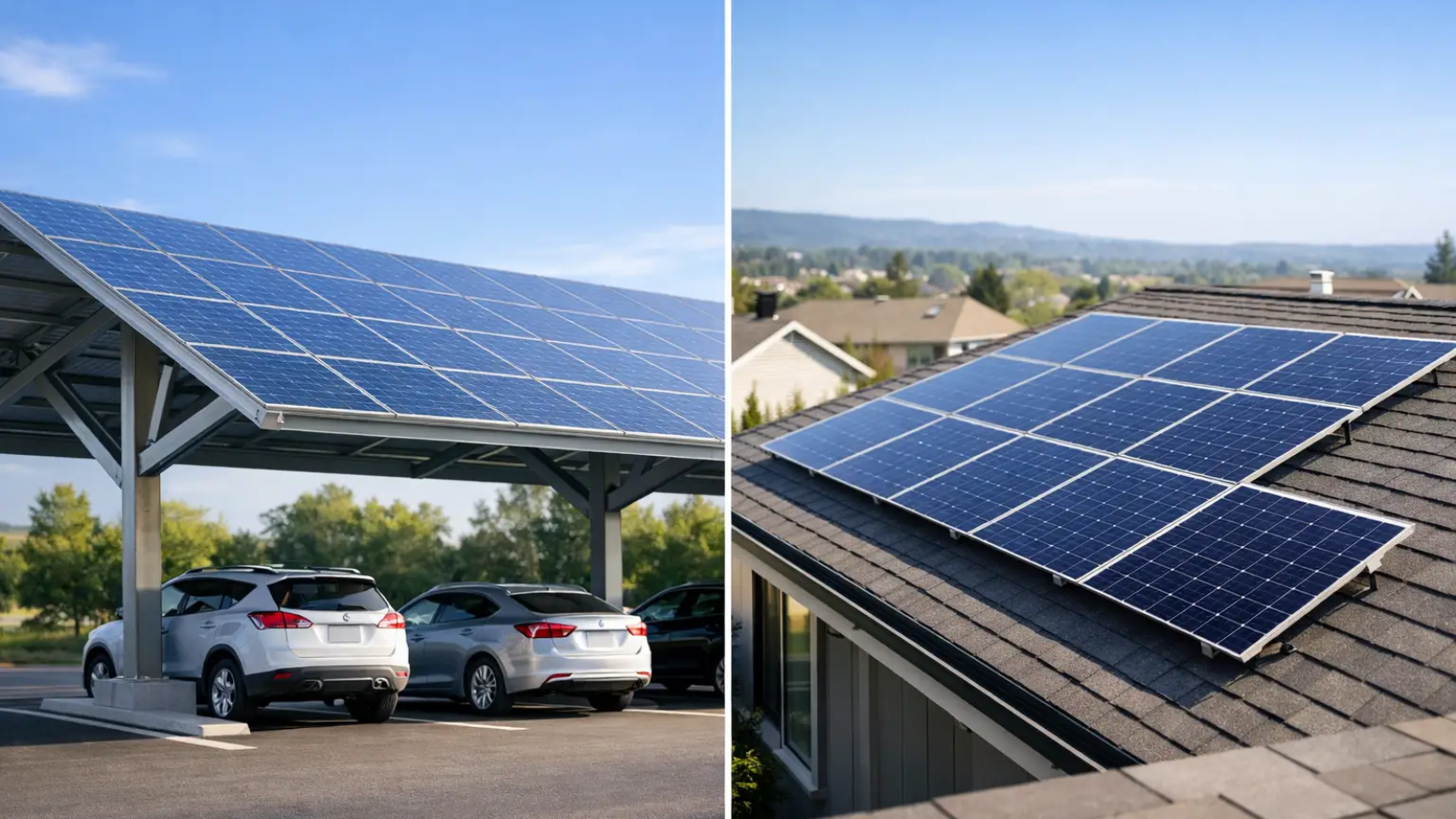
A parking area can do more than hold vehicles. For an EV owner, it can become the most logical place to generate electricity for daily driving. That is why the solar carport vs rooftop solar decision is not simply about panel placement. It is a property, energy-use, budget, and mobility decision – especially for homes and businesses planning to charge electric vehicles on-site.
Rooftop solar remains the default choice because it makes use of existing structure. Solar carports, meanwhile, turn open parking into productive energy infrastructure while adding shade and creating a natural home for EV chargers. Neither option is automatically better. The right system is the one that produces reliable clean power without creating avoidable construction, permitting, or operational challenges.
Solar Carport vs Rooftop Solar: The Core Difference
Rooftop solar mounts panels on an existing roof, using space that might otherwise sit unused. For many homes, this is the most straightforward path to solar because the building already provides the supporting structure. A well-oriented, unshaded roof can deliver strong production with relatively limited site disruption.
A solar carport is a purpose-built canopy with photovoltaic panels overhead. It requires foundations, support columns, drainage planning, and electrical work in addition to the solar equipment itself. That added construction usually raises the upfront price, but it also creates a new functional asset: covered parking that generates electricity.
For commercial properties, multifamily housing, schools, workplaces, and retail locations, the distinction can be significant. A roof may have limited usable area, aging materials, rooftop equipment, or structural restrictions. A parking lot may offer much more room for solar generation, particularly when the property expects EV charging demand to grow.
Start With Your Available Space
The best comparison begins with a site assessment, not a product preference. Rooftops need enough clear, structurally sound space to accommodate panels. Chimneys, vents, skylights, HVAC equipment, dormers, and fire-access setbacks can reduce the area available for an array. Nearby trees and taller buildings can also cut production during valuable daylight hours.
Carports need unobstructed parking or paved space, room for columns, and a layout that preserves safe vehicle movement. They are often a strong option where roofs are small, heavily shaded, unsuitable for additional load, or reserved for other equipment. They can also help properties with multiple parking rows scale solar capacity beyond what the main building can support.
Orientation matters in both cases. Panels should be positioned to capture as much sunlight as practical over the year, but carports often provide more flexibility than roofs. A canopy can be designed at an optimal tilt and direction rather than conforming to an existing roofline. That advantage can improve output, although it must be weighed against the cost of building the structure.
Cost: Lower Entry Price vs. Broader Value
Rooftop solar generally has lower upfront construction costs because the roof already exists. Installation still involves engineering, mounting equipment, wiring, permits, and potentially roof repairs, but it does not require a new steel or concrete structure. For a homeowner with a relatively new roof and good solar access, rooftop solar is often the more cost-efficient first step.
Solar carports typically cost more per watt of installed solar capacity. Foundations, structural steel, weatherproofing, lighting integration, drainage, and parking-lot work all add to the project scope. The gap can narrow when a property already plans to build covered parking, upgrade a lot, add EV chargers, or replace an aging roof that would otherwise need work before solar installation.
The financial case should also consider what the structure delivers beyond electricity. Shade can make vehicles more comfortable, protect interiors from sun exposure, and improve the experience of charging during hot or wet weather. For businesses, a visible solar canopy can reinforce a commitment to cleaner transportation at the point where customers and employees arrive.
Available federal, state, utility, and local incentives may affect the economics of either system. Incentive rules change, and eligibility can depend on ownership structure, project size, location, and the type of property. Review current requirements with qualified tax, legal, and solar professionals before relying on projected savings.
EV Charging Changes the Equation
If EV charging is central to the project, solar carports offer a practical design advantage: generation and charging can be located in the same parking area. This can simplify the customer experience and create a clear connection between clean power and electric mobility. Drivers park, plug in, and charge beneath the solar canopy.
That does not mean rooftop solar cannot support EV charging. A rooftop system can offset electricity used by a garage charger, driveway charger, or commercial charging station elsewhere on the property. In most grid-connected systems, solar production is not necessarily routed directly into a specific charger at every moment. Instead, the system works with the property’s electrical service, utility rules, and, where applicable, battery storage.
The key question is whether the site has enough electrical capacity and the right equipment to support planned charging. A carport located far from the electrical service may require substantial trenching or conduit runs. Conversely, rooftop solar above a building with an existing electrical room near parking may be easier to connect than it first appears. Good design follows the electrical path, not just the panels.
Installation and Maintenance Considerations
Rooftop projects can be quicker to build when the roof is in good condition and access is straightforward. Before installation, the roof should have sufficient remaining life. Removing and reinstalling panels for a future reroof adds cost and disruption, so many owners address roof replacement first when needed.
Carport construction is more involved. The site may need geotechnical review, excavation, concrete footings, drainage adjustments, and traffic management during installation. Local zoning rules, setbacks, height limits, stormwater requirements, and parking regulations can all shape the final design. Commercial projects may also need careful phasing so operations can continue while parking spaces are temporarily unavailable.
Maintenance is manageable for both systems, but access differs. Rooftop panels can be harder to reach for inspections or cleaning, while carport panels are easier to access from lifts or designated maintenance areas. Carports also require periodic attention to structural components, gutters, lighting, and protective elements around columns.
When Rooftop Solar Is the Better Fit
Rooftop solar is usually the stronger choice when a property has a durable, unshaded roof with enough usable area and the main goal is reducing electricity costs with the lowest practical upfront investment. It works particularly well for homeowners with predictable household use and an EV charger near the home’s electrical panel.
It can also be the right first phase for businesses. Installing rooftop capacity now may reduce energy bills and provide useful operating data before a larger parking-lot charging project is needed. A phased approach can protect capital while leaving room for future carport expansion.
When a Solar Carport Makes More Sense
A solar carport is often worth serious consideration when parking is abundant, roof space is constrained, or EV charging is a visible part of the property strategy. It is especially compelling for workplaces, fleets, apartment communities, campuses, hospitality sites, and retail locations where drivers spend meaningful time parked.
Choose a carport for its full value, not just its panel output. The project can combine clean generation, weather protection, charging infrastructure, site branding, and improved parking comfort in one investment. For properties where those benefits matter, the higher construction cost may be justified.
Before committing to either path, evaluate four connected factors: usable solar area, roof or ground conditions, electrical capacity, and future EV charging demand. A system sized only for current electricity use may feel undersized sooner than expected as transportation becomes more electric.
The most future-ready properties do not treat solar and charging as separate upgrades. They plan the parking, power, and people using the site as one connected energy system. That approach helps every new panel and charger serve a clearer purpose: making clean transportation easier to choose every day.
Add a Comment